Certification standards
These standards explain what the Certified Cleaning Business Professional (C.C.B.P.) credential represents and how it is awarded, so students, clients, and employers can trust what it stands for.
1. What the credential represents
The C.C.B.P. credential signifies that the holder has completed Cleaning Business Institute training and demonstrated a working knowledge of how to set up, price, and operate a professional cleaning business, and how to win its first clients. It recognizes practical business readiness. It is not a license, and it does not replace any registration, insurance, or permit required in the holder's location.
2. Eligibility
Any enrolled student may work toward the credential. There are no prior education or experience requirements to begin. The certification is available to students of both the Fundamentals and Fast Track courses.
3. How candidates are assessed
To earn the credential, a candidate must complete their course and pass the final assessment. The assessment is an open-book online exam combining multiple-choice and short written answers. A candidate must score at least 70 out of 100 to pass. Multiple-choice answers are graded automatically; written answers are reviewed by our team to confirm genuine understanding rather than recall alone.
4. What the exam checks, unit by unit
The exam is built from the course units, so passing it means a candidate has shown each of the following.
- Cleaning Business Foundations. Chooses a residential, commercial or specialty niche against their own cash and hours, confirms that local customers already pay for it, and builds a startup budget that includes the costs most first budgets leave out.
- Setting Up Your Business. Chooses a business structure, completes the local registration and licensing steps in the right order, keeps business money in its own account, and writes cancellation, payment and access policies clients can understand.
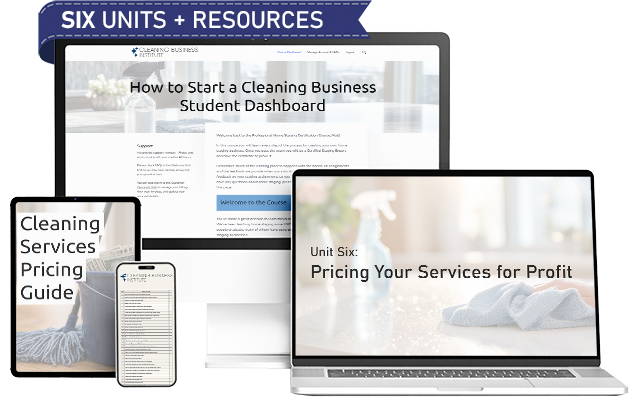
- Pricing Your Services for Profit. Works out the real cost of an on-site hour from billable time rather than a forty-hour week, chooses between hourly, flat-rate and square-footage pricing for each job, and holds a quoted price under pushback.
- Cleaning Techniques and Standards. Cleans a room in an order that never doubles back, works safely with chemicals (never mixing products, labeling decanted bottles), sets a written quality standard, and adjusts scope for deep cleans, move-outs and post-construction work.
- Client Experience and Retention. Onboards a new client without gaps, communicates so nobody has to chase them, resolves a complaint within the first hour in a way that keeps the client, and asks for reviews and referrals as a routine.
- Getting Your First Clients. Launches in a single week by working a personal network, setting up free local listings, answering inquiries so they become bookings, and making an introductory offer that does not give away a client's lifetime value.
- Marketing on a Budget. Decides what marketing has to achieve before spending on it, builds a simple site and a complete local listing, costs a door drop per client won, and sets up referral partnerships with trades already working in local homes.
- Systems for Efficiency. Keeps every client, job and invoice in one system, schedules by geography with buffers, writes per-client checklists that hold the standard on bad days, and automates invoices and payment reminders.
- Hiring and Growing Your Team. Uses the numbers to decide when to hire, explains the practical difference between an employee and a subcontractor, vets a candidate with a paid working session before they hold a key, and trains to a written standard.
- Scaling and Long-Term Growth. Hands tasks over in a sensible order to step off the tools, prices and wins recurring commercial contracts, expands area or services without breaking route density, and reviews six core numbers every month.
5. How the C.C.B.P. fits alongside licenses and other certifications
The C.C.B.P. is a training certificate in running a cleaning business. It is not a government license, and in the United States there is no national license to clean homes or offices. What an owner actually needs is set locally: a state or local business registration, any city or county business license, and sometimes a permit for particular services. Most owners also carry general liability insurance, and many add a janitorial bond, which reimburses a client if an employee steals from them. The credential does not replace any of these, and Units 1 and 2 of the course show how to find out exactly which ones apply where you trade. Our guide to what licenses a cleaning business needs covers the same ground in more detail.
Several respected third-party credentials exist in this industry, and most of them certify technical skill or an organization rather than a business owner. The IICRC certifies technicians in specialties such as carpet cleaning and water damage restoration. ISSA, the cleaning industry association, publishes the Cleaning Industry Management Standard (CIMS), which certifies cleaning organizations after an assessment, and it runs its own training programs. Green Seal certifies commercial cleaning services to its GS-42 standard, and CIMS has a green building version. None of these is required to open a residential cleaning business, and each is worth pursuing when the work you want calls for it.
Safety training is a separate matter again. OSHA does not certify cleaners, but employers are required to train staff on the hazardous chemicals they use, and workers with occupational exposure to blood, which can include some commercial and medical cleaning, need bloodborne pathogens training. OSHA Outreach courses issue a completion card rather than a certification.
The C.C.B.P. sits beside all of this rather than competing with it. A technical certification shows you can clean a carpet or dry a flooded room to a recognized standard. This credential shows you can price that work for profit, put it in writing, win and keep clients, and hire people to deliver it. Many owners end up holding both kinds, and we would encourage anyone moving into restoration, carpet or healthcare work to add the technical certification that specialty expects.
6. Issuing the certificate
On passing, each candidate receives a personalized digital certificate showing their name, the course completed, and the date of issue. Every certificate carries a unique verification ID so its authenticity can be confirmed independently at any time.
7. Validity and use
The credential does not expire and carries no renewal fee. Holders may reference it in their marketing and client communications, provided they represent it accurately, as a sign of completed training, not as a government license or a guarantee of any specific result.
8. Maintaining standards
Holders are expected to uphold the Member Code of Conduct. We reserve the right to revoke a credential obtained through dishonesty in the assessment, or used to misrepresent the holder's qualifications. Revoked credentials are marked invalid on the verification page.
9. Verifying a certificate
Anyone can confirm a certificate is genuine on our certificate verification page by entering the verification ID printed on it.
Questions about these standards? Contact us.