How to Start a Cleaning Business, From Plan to First Client
To start a cleaning business, choose the kind of cleaning you will sell, register the business with your city or county, buy liability insurance, price each job from your real costs, and book your first clients through the people and neighborhoods you already know.
None of that needs a large sum. Because there is no premises to lease and the kit is small, most of the startup bill is supplies, filing fees and the first insurance premium. The order matters more than the speed. An owner who advertises before they are insured, or quotes before they know their costs, usually has to undo something later.
This guide walks the whole route in the order that works, and links to a fuller guide at each step for anyone who needs the detail.
The figure below shows that route from start to finish, with what each step hands on to the next one.
- 1
Choose the service and the client
Decide between homes and workplaces, and pick a niche inside that choice.
Hands on the scope every later step is sized to - 2
Write a short plan
Name the client, the services, the price range and how the first jobs will be found.
Hands on a budget and a target - 3
Register and insure
Pick a structure, file the name, get local registrations and buy liability cover.
Hands on a business that can legally take money - 4
Price from real costs
Work out labor, supplies, overhead and profit for a typical job.
Hands on a quote you can defend - 5
Book the first clients
Start with your own network, free listings and a clear introductory offer.
Hands on reviews and repeat bookings - 6
Build systems, then hire
Write checklists and schedules so someone else can clean to your standard.
Nobody has to finish every step perfectly before starting the next. But skipping one, especially insurance or costing, tends to show up as a problem within the first few months.
Choose the kind of cleaning business you will run
The first decision shapes every one after it. Residential cleaning (homes and apartments) and commercial cleaning (offices, shops and other workplaces) run on different hours, different paperwork and different selling, so it pays to start with one even if you plan to offer both later.
The table below sets the two side by side on the points that most affect a new owner's first year.
| Point | Residential | Commercial |
|---|---|---|
| Who pays | A household, usually at each visit | A business, usually on a monthly invoice |
| When you work | Weekday daytime | Evenings, early mornings and weekends |
| How work is won | Referrals, reviews and local listings | Walk-throughs, proposals and bids |
| What clients check | Trust, reviews and who enters the home | Insurance certificates and references |
| Starting kit | Household-scale supplies and a vacuum | Larger equipment as accounts grow |
Most new owners start on the residential side because a first job can be booked this week and paid on the day.
Across the students we work with at the Cleaning Business Institute, about two in three of the businesses launched in the last two years have taken households rather than companies as their first customers. That makes sense for a business with no track record yet.
Commercial work pays in larger, steadier amounts, but the sales cycle is longer and buyers ask for paperwork a new business may not have yet.
Our guides to starting a house cleaning business and starting a commercial cleaning business cover each side in depth.
Narrow it further with a niche
Inside each market sit narrower niches. A niche is a defined type of job for a defined client, and it makes marketing easier because the owner knows exactly who to talk to. The common starting niches are these:
- Vacation rental turnovers between guests, covered in our guide to starting an Airbnb cleaning business.
- Move-out cleans for tenants, landlords and property managers, covered in starting a move-out cleaning business.
- After-hours office cleaning, which has its own rules about keys and alarms, covered in starting an office cleaning business.
- Specialty work such as windows or carpets, which needs its own equipment and, for work at height, its own safety training.
Before choosing, it is worth being honest about whether the work suits you at all. Our guide on whether you should start a cleaning business sets out the pros, the cons and the kind of person who tends to enjoy it.
Write a short plan and make the business legal
Once the service is chosen, a short plan turns it into numbers. It does not need to run to fifty pages. A few pages naming the client, the services, the price range, the startup budget and how the first clients will be found are enough to make decisions with, and our guide to writing a cleaning business plan shows that shorter shape.
Pick a structure and a name
With a plan in hand, the next choice is the legal structure. Most cleaning owners start as a sole proprietor, which needs almost no paperwork, or form a limited liability company (LLC), a structure that keeps business debts and lawsuits away from personal assets.
The Small Business Administration sets out the trade-offs, and our guide to getting an LLC for a cleaning business covers forming one.
Then choose a name, check that it is free in your state, and file a DBA ("doing business as") if you will trade under a name other than your own. The cleaning business name generator helps when the obvious names are taken.
Register, license and insure
Registration is simpler than most people fear. In most states there is no license specifically for cleaning. What most owners do need is a general business license or registration from the city or county, and an Employer Identification Number (EIN), which the IRS issues free and which banks usually ask for.
Some states also tax certain cleaning services, which means registering to collect sales tax. Because these rules vary by state and even by city, check your state's own business and revenue websites rather than relying on a national list. Our guides to which licenses a cleaning business needs and how to register a cleaning business go through each filing.
Insurance is the one item not to postpone. General liability insurance pays if you damage a client's property or someone is hurt because of your work. Workers' compensation becomes a legal requirement in most states once you hire. Bonding, which repays a client if an employee steals, is something clients ask for rather than something the law usually requires.
For the detail on each, read what cleaning business insurance covers and costs and how to get bonded.
Budget the startup costs and price every job
With the paperwork underway, the question becomes money, both what goes out before the first job and what comes in from each one.
For a solo residential business the startup bill is mostly supplies, a good vacuum, filing fees and the first insurance premium. The startup cost calculator puts a figure on your own version, and our guide to what it costs to start a cleaning business explains each line.
Pricing is where new owners most often go wrong. A quote built only on the hours spent cleaning leaves out travel, supplies, insurance, software and the profit the business needs, so a rate that sounds generous turns out thin once the month's bills arrive.
A worked price for one clean
The example below is an illustration, not a market rate. It prices a three-hour house clean for an owner who wants $25 for every hour of working time, counting the half hour of travel, and who spreads $480 of monthly overhead across 40 cleans.
A $75 quote would fall $30.50 short of the job's own costs before the business made anything at all.
Change any assumption and the price moves, which is the point of doing the sum. The cleaning price calculator runs it for your own numbers. For the choice between hourly, flat-rate, per-room and square-foot pricing, read how to price cleaning services, and for quoting a single job, how to charge for cleaning services.
Profit is not the same as take-home pay. Self-employed owners pay self-employment tax at 15.3% on top of income tax, and the IRS self-employment tax guidance explains how it works. Setting part of every payment aside in a separate account avoids an ugly surprise at tax time. The cleaning business earnings calculator shows what a full week of jobs adds up to.
Gather the supplies and learn to clean to a standard
With prices set, the kit can be bought to match the services sold, and it is smaller than most people expect. A residential starter kit usually covers the following:
- Microfiber cloths in several colors, one color per area so bathroom cloths never reach a kitchen counter.
- An all-purpose cleaner, a glass cleaner, a bathroom cleaner and a registered disinfectant.
- A vacuum with attachments, a flat mop and bucket, scrub brushes and a toilet brush.
- Gloves, trash bags, an extension duster and a caddy to carry it all between rooms.
Our guide to cleaning business supplies breaks the kit down by service type, and the checklist in what you need to start a cleaning business puts the legal, money and systems items on the same page.
Kit only helps if it is used well. Cleaning a client's home is more systematic than cleaning your own. It runs top to bottom, dry work before wet, with each room finished before the next.
Product labels matter too, because a disinfectant only works if the surface stays wet for the contact time printed on it. Anyone new to the work should read our guide to starting with no experience.
Find the first clients and keep them
A well-equipped owner still needs someone to clean for, and the first clients nearly always come from people who already know them. A new owner's first fortnight of selling usually looks like this:
- Tell everyone in your phone and social accounts what you now offer, and ask who they know.
- Set up a free Google Business Profile so local searches can find you.
- Post in neighborhood groups and community boards where they allow it.
- Make one clear introductory offer, such as a reduced first clean that converts to a recurring booking.
- Ask every early client for a review and a referral once the work is done.
Those five moves cost almost nothing, which is why our guide to starting a cleaning business with no money leans on them. For a day-by-day version of the first month, see starting a cleaning business from scratch, and for the wider picture, getting clients and marketing a cleaning business.
Keeping a client is cheaper than finding one. A written agreement that sets out the scope, the price and the cancellation policy prevents most disputes, and the cleaning service contract template is a starting point. Recurring clients on a weekly or fortnightly schedule are what turn a busy month into a stable business.
The rules in your state
Most of the legal setup above is the same everywhere, but the details change at the state line. Sales tax is the clearest example. Some states tax house cleaning, some tax only commercial work, and some tax neither.
Workers' compensation, business registration and local licences vary just as much. We have written a full guide for five of the largest markets:
- How to start a cleaning business in Florida
- How to start a cleaning business in Texas
- How to start a cleaning business in California
- How to start a cleaning business in Ohio
- How to start a cleaning business in North Carolina
If your state is not on the list yet, the licensing guide explains what to look for on your own state's websites.
Build systems before you hire help
Once the calendar is full, the business stops growing unless someone other than the owner can clean to the same standard. That depends on three systems written down before the first hire. They are a room-by-room checklist, a booking and reminder routine, and a simple way to invoice and chase payment.
Software helps once the client list outgrows a paper diary, and our guide to the best CRM for a small cleaning business explains what to look for. The weekly rhythm of a working business is covered in how to run a cleaning business.
Hiring brings new obligations. An employee means payroll, tax withholding and workers' compensation, while a contractor must genuinely control how they do the work. Our guides to hiring cleaners, growing a cleaning business and scaling beyond the owner take it from there.
How the course fits
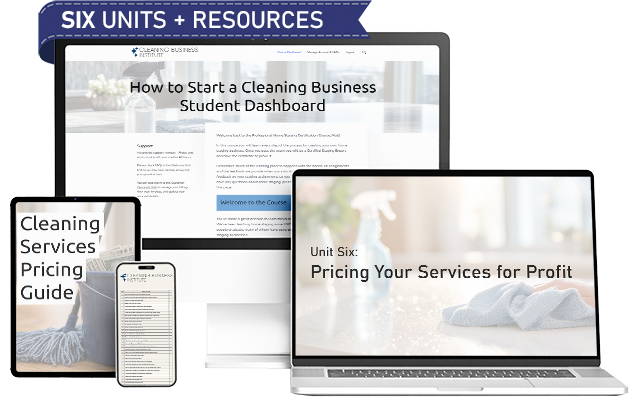
The Fundamentals Course follows the same route as this guide across six units. They are Cleaning Business Foundations, Setting Up Your Business, Pricing Your Services for Profit, Cleaning Techniques and Standards, Client Experience and Retention, and Getting Your First Clients. Each goes further than a guide can, with worked pricing examples, contract clauses and outreach scripts.
The Fast Track Course includes those six units and adds Marketing on a Budget, Systems for Efficiency, Hiring and Growing Your Team, and Scaling and Long-Term Growth. Both end with the same online exam for the C.C.B.P. credential. If you are unsure which suits your plans, the short cleaning business quiz points you to one.
Ready to get started?
Our step-by-step courses take you from where you are now to a credential you can show, with templates, an online exam, and a 30-day money-back guarantee.
See the courses