How to Start a Cleaning Business From Scratch in 30 Days
Starting a cleaning business from scratch takes about 30 days of steady work. In week one you decide what you sell and what it costs, in week two you make the business legal and insured, in week three you start finding clients, and in week four you deliver the first cleans and turn them into repeat bookings.
The plan below gives each day a job. It assumes a solo owner starting with residential cleaning, working on the business for a few hours most days alongside other commitments, and it can be stretched to six weeks without losing anything except time.
The figure below shows the month at a glance, with what each week has to hand to the next.
- 1
Days 1 to 7, decide and price
Choose the service, the client and the area, then build a price for a typical job.
Hands on a price list and a name - 2
Days 8 to 14, make it legal
Register, open a bank account, buy liability insurance and write the paperwork clients will sign.
Hands on a business that can take money - 3
Days 15 to 21, find clients
Tell your network, set up free listings and make one introductory offer.
Hands on booked first cleans - 4
Days 22 to 30, clean and rebook
Deliver the first jobs to a checklist, collect payment and ask for the next booking.
The order matters more than the exact dates. Insurance comes before advertising, and pricing comes before the first conversation with a client, because both are hard to fix once someone has said yes.
Week one, decide what you sell and what it costs
The first week is all decisions and no spending. By day seven the owner should be able to say, in one sentence, who they clean for, what a standard visit includes and roughly what it costs.
- Day 1. Choose between residential and commercial work, and if residential, between standard recurring cleans, deep cleans, move-outs or vacation rentals. Our pillar guide to how to start a cleaning business compares them.
- Day 2. Draw your service area on a map. A tight radius means less unpaid driving between jobs.
- Day 3. Write down exactly what a standard clean includes, room by room, and what counts as an extra.
- Days 4 and 5. Time yourself cleaning your own home to that list, then work out a price from your labor, supplies, overhead and profit. The cleaning price calculator does the arithmetic.
- Day 6. Choose a name and check it is free in your state. The name generator helps if you are stuck.
- Day 7. Write a one-page plan with the service, the client, the price and the target for month one.
Timing your own home on days four and five is the step most people skip, and it is the one that stops a new owner underquoting. A three-bedroom house that took four hours to clean properly should not be quoted as a two-hour job.
Week two, make it legal and insured
With the decisions made, week two turns them into a business that can legally take money. Most of it is filing and phone calls, and most of it costs little.
- Day 8. Decide between trading as a sole proprietor and forming an LLC. Our guide to an LLC for a cleaning business sets out the difference.
- Day 9. File the business name or DBA if you will trade under a name other than your own, and apply for an Employer Identification Number from the IRS, which is free.
- Day 10. Contact your city or county about a business license or registration, and check with your state's revenue department whether your services are subject to sales tax.
- Day 11. Open a separate business bank account and set up a payment method that takes cards.
- Days 12 and 13. Get quotes for general liability insurance and buy a policy before any paid clean for someone outside your family.
- Day 14. Write the paperwork clients will see, from the service agreement to the cancellation policy.
Licensing is the step people worry about most, and it is usually the simplest. Most states have no license specifically for cleaning, but local rules differ, and the SBA's licenses and permits guide explains how federal, state and local requirements fit together. Our guide on which licenses a cleaning business needs goes further.
By the end of day 14 a new business should hold five working documents. Each one does a different job, and the definitions below show what that job is.
- Price list
- What a standard clean, a deep clean and each extra costs, so every quote starts from the same numbers.
- Cleaning checklist
- The room-by-room tasks in a standard visit, which is also the scope the client is paying for.
- Service agreement
- Scope, price, schedule and what happens if either side wants to change or end the arrangement.
- Cancellation policy
- How much notice a client must give and what a late cancellation or locked door costs.
- Invoice
- A numbered bill with the date, the work done, the amount and how to pay.
Every one of these can start from a template. The cleaning business templates include a price list, a service checklist, a contract and an invoice ready to edit.
Week three, start finding clients
Paperwork in hand, the business can now be told to the world. Week three is about conversations, not sales, and a good week ends with a handful of booked first cleans.
- Day 15. Message everyone you know personally, saying what you offer, where, and asking who they know.
- Day 16. Set up a free Google Business Profile with your service area, hours and photos of real work.
- Day 17. Post in neighborhood groups and community boards that allow local businesses.
- Day 18. Decide on one introductory offer, such as a reduced first clean for clients who book a recurring visit.
- Days 19 to 21. Follow up every reply within the day, book walk-throughs, and give written quotes.
Speed of reply wins more early clients than polish. Our guides to getting the first clients and introducing your cleaning business include scripts for the messages in this week.
Week four, clean, collect and rebook
The last stretch is where the business starts paying. The aim for days 22 to 30 is not only to deliver the first cleans well but to leave each one with the next visit already in the diary.
- Arrive on time with the checklist, and work through it in the same order every visit.
- Walk the client through what was done before you leave, and fix anything they point out on the spot.
- Take payment on the day, and send a receipt or invoice the same evening.
- Offer a recurring slot before you leave, weekly or fortnightly, at the price you quoted.
- Ask happy clients for a review and the name of one person who might want the same service.
Rebooking is what makes the month count. A recurring client on a fortnightly schedule fills two slots every month without any more marketing, which is why the first few should be treated as long-term relationships rather than one-off jobs.
What to do if day 30 arrives without clients
Not every first month ends with a full diary, and it is worth knowing in advance that the slow part is usually selling rather than setting up. The Federal Reserve's Small Business Credit Survey found that reaching customers was an operational challenge for more than half of the firms it surveyed.
Cleaning is no different. Here at the Cleaning Business Institute, a little over half of the students who say they stalled in their first month over the past two years tell us the sticking point was finding clients, not the setup. The fix is more conversations, not more paperwork, so repeat week three with a wider circle before changing anything else.
If money is the constraint rather than clients, our guide to starting with no money shows what can wait. If confidence is the issue, starting with no experience covers building skill before the first paid job.
How the course fits
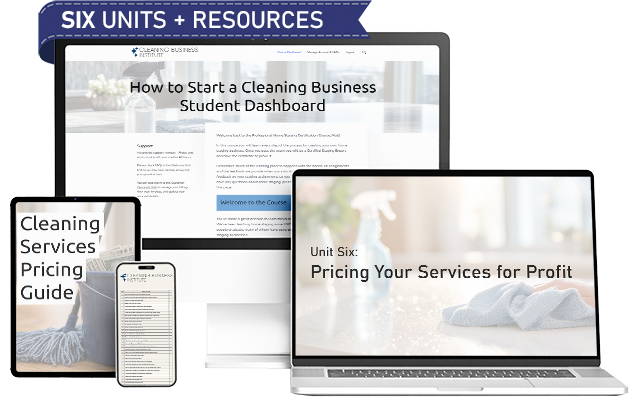
The Fundamentals Course follows this month closely. Cleaning Business Foundations and Setting Up Your Business cover weeks one and two, Pricing Your Services for Profit works through the costing in detail, and Getting Your First Clients opens with launching in a week and judging that week by conversations started.
Client Experience and Retention then covers week four, from onboarding to rebooking. The Fast Track Course adds four units on marketing, systems, hiring and scaling for the months that follow. Both end with the online exam for the C.C.B.P. credential.
Ready to get started?
Our step-by-step courses take you from where you are now to a credential you can show, with templates, an online exam, and a 30-day money-back guarantee.
See the courses