LLC for a Cleaning Business, When It Pays and How to Form One
An LLC for a cleaning business is worth forming once the business has assets to protect, staff, or commercial clients who expect one. Before that, a sole proprietorship is cheaper and simpler, and good insurance does more of the protecting than the LLC does. Forming one takes a state filing, a registered agent, an operating agreement and usually an EIN.
The protection an LLC (limited liability company) gives is real but narrower than its reputation. It separates business debts and claims from the owner's personal assets, as long as the owner keeps the two apart. It does not shield an owner from the results of their own careless work, which is the part most cleaners never hear.
What an LLC actually protects
An LLC is a separate legal entity. Contracts, debts and most claims belong to the business, so a creditor of the business generally cannot reach the owner's home, car or savings. That is the "limited liability" in the name.
The catch is that the protection covers the business's obligations, not the owner's own actions. If an owner personally knocks a client's television off a wall, the owner can usually still be sued for it, LLC or not.
What the LLC adds is protection from things the owner did not personally do, such as a lease the business cannot pay or a mistake made by an employee.
Here is how that plays out. Suppose a two-person business signs a commercial contract, and an employee floods an office kitchen while the owner is cleaning across town. The claim is against the business.
With an LLC and a policy in place, the insurer handles it and the owner's house is not part of the conversation. As a sole proprietor, the owner is the business, so the claim is personal.
That is why insurance comes first for most cleaners. General liability insurance pays for accidental damage and injury whatever the structure, and our guide to cleaning business insurance covers it. The LLC is a second layer, and it earns its cost as the business takes on staff, contracts and debt.
LLC or sole proprietor for a cleaning business
The two structures most cleaners choose between differ in a handful of practical ways. The Small Business Administration's guide to business structures covers the full range, including corporations and partnerships, but these are the differences that matter for a cleaning business.
| Point | Sole proprietor | Single-member LLC |
|---|---|---|
| Formation | None, beyond local licenses | A filing with the state |
| Business debts and claims | The owner's personally | Usually the LLC's alone |
| Federal income tax | Schedule C on the owner's return | The same by default |
| Ongoing upkeep | Very little | Annual report and fee in most states |
| How clients see it | Fine for most homeowners | Often expected by commercial clients |
The tax row surprises people. By default the IRS treats a single-member LLC as a "disregarded entity", meaning its income goes on the owner's personal return just as a sole proprietor's would. The IRS page on single-member LLCs explains this, along with the option to elect corporate treatment later.
So the choice is mostly about liability and paperwork, not tax. An LLC can elect to be taxed as an S corporation once profits are high enough to make it worthwhile, but that is a decision for an accountant, made on real figures.
When forming an LLC makes sense
There is no single right moment, but a few situations tip the balance clearly toward an LLC. If any of these applies, the cost and upkeep are usually worth it.
- The first employee is coming. The owner becomes responsible for other people's work in clients' homes and buildings.
- Commercial contracts are the target. Many commercial clients expect to contract with an entity, and our guide to getting cleaning contracts covers what they check.
- The business is taking on debt or a lease. A van loan or a storage unit in the business's name is exactly what the LLC keeps separate.
- The owner has assets worth protecting. A paid-off home or significant savings raises the stakes of a claim.
Most owners reach at least one of these within a few years. Among the graduates we hear from at the Cleaning Business Institute after their first hire, only about one in eight is still trading as a sole proprietor by the time that hire starts, a pattern that has held over the past three years.
An owner testing the idea with a handful of house clients, with insurance in place, can reasonably start as a sole proprietor and convert later. The trade-off is that the conversion means updating the bank account, licenses and contracts into the new name.
How to form an LLC, step by step
The process is broadly the same in every state, though forms, fees and names differ. Doing it in this order means each step has what it needs from the one before.
- 1
Check the name
Search the Secretary of State's database, and include "LLC" or the state's required wording.
Hands on an available legal name - 2
Name a registered agent
The person or service that accepts legal papers for the LLC at an in-state address.
Hands on the agent the filing must list - 3
File the articles
Submit articles of organization, or a certificate of formation, and pay the state fee.
Hands on the approved LLC - 4
Write an operating agreement
Set out ownership and how decisions are made, even for a one-owner LLC.
- 5
Get an EIN and open the account
Apply to the IRS, then open a business bank account in the LLC's name.
A few of these steps carry choices worth slowing down for. The ones below are where new owners most often go wrong.
Registered agent and address
An owner can usually act as their own registered agent, but the address becomes public record. A home-based cleaner who would rather keep their home address off the state database can pay a registered agent service to use theirs instead.
Which state to form in
Form the LLC in the state where the business cleans. An LLC formed elsewhere for a reputation of low fees or privacy still has to register in the home state as a foreign LLC, which means two sets of fees and reports for a business that only operates in one place.
State costs and extra steps
Filing fees and annual fees are set by each state, so check the Secretary of State's own fee schedule. A few states add requirements, such as California's annual minimum franchise tax on every LLC and New York's rule that new LLCs publish a notice of formation. The IRS overview of LLCs covers the federal side, which is the same everywhere.
One federal filing has dropped away. FinCEN's beneficial ownership page now states that companies created in the United States are exempt from beneficial ownership reporting, so an online service that warns otherwise is out of date.
Keeping the protection once you have it
An LLC only protects an owner who runs it as a separate business. Courts can set the protection aside, which lawyers call piercing the corporate veil, when the owner treats the business's money as their own.
Keeping the line clear takes a few habits rather than any expense.
- Pay every business cost from the business account, and pay yourself by transfer, never by spending from it directly.
- Sign contracts, quotes and invoices in the LLC's name, with "LLC" shown.
- File the annual report and pay any state fee on time, since a lapsed LLC can be dissolved.
- Keep insurance in force, because the LLC does not replace it.
The cleaning service contract template is a good place to start, since putting the business's legal name on every agreement is the simplest of these habits.
Where the course covers business structure
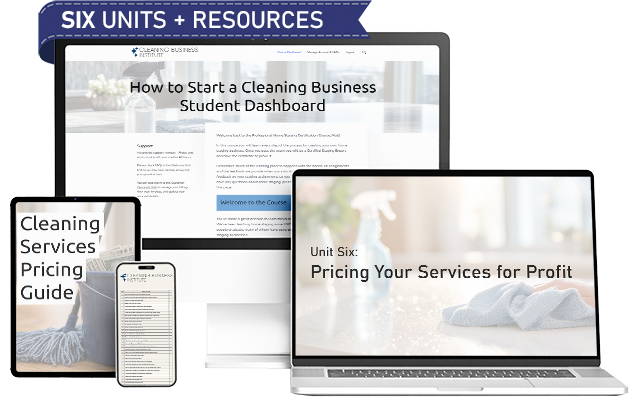
Choosing a structure is taught in Unit 2 of the course, Setting Up Your Business, alongside registering the business name, opening the business bank account and setting up bookkeeping that keeps business and personal money apart. Unit 1, Cleaning Business Foundations, introduces the legal basics when planning the launch budget.
Both units are in the Fundamentals Course. The Fast Track Course includes them and adds Unit 9, Hiring and Growing Your Team, which is where the case for an LLC usually becomes hard to ignore. For the other filings that sit alongside the LLC, see our guide on how to register a cleaning business.
Ready to get started?
Our step-by-step courses take you from where you are now to a credential you can show, with templates, an online exam, and a 30-day money-back guarantee.
See the courses