How to Start a Cleaning Business in Ohio

To start a cleaning business in Ohio, register an LLC or trade name with the Ohio Secretary of State, get a vendor's license for sales tax, and buy workers' compensation from the state's own fund before the first employee starts. Ohio taxes house cleaning as well as office cleaning once a business sells $5,000 of it in a year.
Many Ohio cities also tax business profits. Those two points make Ohio one of the more involved states for a new cleaner. Neither is difficult once understood, but both catch owners who copied a checklist written for another state. This guide takes each Ohio requirement in turn and links the state's own guidance.
Registering the business with the Ohio Secretary of State
The state filing comes first. A sole proprietor using their own legal name has nothing to register, but one trading as "Buckeye Bright Cleaning" registers that trade name with the Ohio Secretary of State. An owner forming an LLC files articles of organization with the same office instead.
Ohio has no state license for cleaning, and the Secretary of State's filing is not a license to trade. Local zoning still applies to a home-based business, so a check with the city or township on parking, signage and client visits belongs on the list. Our guide to registering a cleaning business covers the name search and filing in more detail.
Ohio taxes house cleaning once sales reach $5,000
Ohio taxes residential cleaning, which many states do not. The Ohio Department of Taxation's information release on building maintenance and janitorial services says the taxable service includes washing, vacuuming, dusting and polishing in offices, houses and other buildings, and names housekeeping and maid service directly.
The release also sets a threshold. A business with less than $5,000 in sales of this service during a calendar year is outside the definition. Once it reaches $5,000, it must register and collect tax on all sales from then on, until it stops trading.
What the tax covers and what it does not
Ohio draws its line around cleaning a building and the things inside it, which pulls in more services than people expect. The release gives examples on both sides.
| Taxable janitorial service | Not a janitorial service |
|---|---|
| House and maid cleaning | Cleaning outdoor pools |
| Carpet and upholstery cleaning | Applying stain repellent to carpet |
| Window, wall and ceiling cleaning | Unclogging drains and pipes |
| Power washing building exteriors and gutters | Painting and minor repairs |
| Cleaning ducts and indoor pools | Stripping paint or wallpaper |
The right-hand column has a trap. Snow removal, lawn debris clearing and off-site drapery cleaning are not janitorial services, but the release notes that each is taxed under a different heading, so adding them does not make an invoice tax-free.
Licensing, rates and invoices
A cleaner collecting the tax needs a vendor's license. The release says it can be obtained through the Ohio Business Gateway or the county auditor's office, for a $25 application fee.
The rate depends on where the building is, not where the business is. A cleaner working in two counties charges each client the rate for the county the client's building sits in. Invoices need care as well, because nontaxable work billed on the same invoice must be listed separately or the whole amount becomes taxable.
The release gives an example that applies to any cleaner who adds exterior work. A power washing company cleans the outside of a house, and the owner asks for the driveway as well. Listed as its own line, the driveway is not taxed. Folded into one price, the whole bill is.
How soon a new business reaches $5,000
The threshold sounds generous, but recurring work reaches it quickly. Here is how that plays out for a new owner with four weekly clients at $150 a visit. The figures are an illustration.
Four regular clients take this business past the threshold in its third month, so the vendor's license belongs in the launch plan.
That is why the license is best treated as a launch task. Pricing with the tax already planned avoids a jump in every client's bill partway through the year, and the cleaning price calculator helps set the base price before tax.
Workers' compensation through the Ohio BWC
Ohio does workers' compensation differently from most states. Coverage comes from the Ohio Bureau of Workers' Compensation's state fund, unless a large employer qualifies to self-insure, so a cleaning business does not shop for a policy from private insurers.
The BWC's application for coverage says any employer with employees hired in Ohio needs a policy, as do independent contractors and subcontractors who have employees. The application carries a $120 nonrefundable fee, and coverage does not begin until the application and fee are received, so it must go in before the first employee's first shift.
Private employers' policies renew every July 1. Liability insurance and bonding are still bought privately, and our guide to cleaning business insurance covers what clients expect to see.
City income tax and the commercial activity tax
Many Ohio cities and villages levy an income tax, and for a business that includes a tax on net profit. A cleaning business owes it to the municipality or municipalities where it works, and sole proprietors file directly with each municipality rather than through the state's central filing option.
Rates, credits for tax paid to another city, and filing dates all vary by municipality. The finance or tax office of each city where the business works regularly is the place to confirm what it expects from a cleaner based elsewhere.
The commercial activity tax, Ohio's tax on gross receipts, worries new owners more than it should. The Department of Taxation's release on the CAT says that from 2025 a business with $6 million or less in taxable gross receipts files no return.
Where the cleaning work is in Ohio
Ohio's markets are spread across several mid-sized metros, each with its own mix of older housing, offices and hospitals. Most new Ohio cleaning businesses start with one of these.
- Recurring house cleaning in the suburbs of Columbus, Cleveland, Cincinnati and Dayton.
- Move-out cleaning for landlords and property managers near the large universities.
- Medical and office cleaning around hospital systems and business parks.
- Post-construction cleaning in fast-growing suburbs, priced with the tax rules above in mind.
Wages in Ohio sit a little below the national level. Across the Ohio students we work with at the Cleaning Business Institute, the wage offered to a first employee has run about a tenth below the national figure for house cleaners over the past two years. That gap helps margins, but it narrows in the larger metros.
Putting the Ohio steps in order
The order matters because some filings depend on others. A new Ohio cleaning business usually works through them like this.
- Register a trade name or form an LLC with the Secretary of State.
- Check local zoning, and find out which cities where you will work levy an income tax.
- Apply for a vendor's license, ideally before launch rather than at $5,000.
- Get an EIN from the IRS if hiring or forming a multi-member LLC.
- Apply to the BWC for coverage before the first employee starts.
The general version of these steps is in our guide on how to start a cleaning business, and the national picture is in our guide to what licenses a cleaning business needs.
Where the course covers starting in Ohio
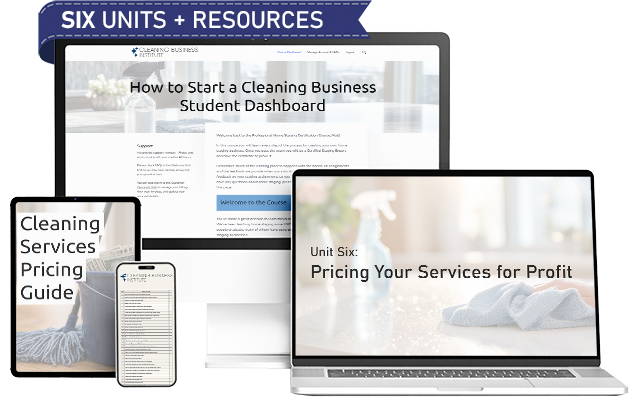
Ohio's tax rules put pricing and bookkeeping at the center of a good start. Unit 2, Setting Up Your Business, covers registration, permits and a bookkeeping system that keeps tax collected apart from income. Unit 3, Pricing Your Services for Profit, covers building prices that hold up once tax is added to the bill.
Both units are in the Fundamentals Course, which covers units 1 to 6. The steps around a first hire, where the BWC application comes in, are taught in Unit 9 of the Fast Track Course.
Ready to get started?
Our step-by-step courses take you from where you are now to a credential you can show, with templates, an online exam, and a 30-day money-back guarantee.
See the courses