Cleaning Business Insurance Cost and the Policies You Need
Cleaning business insurance for a small operation usually starts with general liability, and the published averages put it at roughly $40 to $50 a month. Insureon, an online insurance agency, reports that its cleaning-business customers pay an average of $48 a month, or about $580 a year, for general liability, and $44 a month for house cleaning in particular.
That figure is the floor, not the total. Workers' compensation, a work vehicle and extra limits each add a separate premium, and those can cost more than the liability policy itself. What a given owner pays depends on the services offered, the payroll, the state and the claims history.
The policies a cleaning business carries
Insurance for a cleaning business is a stack of separate policies, and each one covers a different risk. A solo house cleaner may need only the first, while a company with a crew and a van needs most of them.
| Policy | What it pays for | When it becomes necessary |
|---|---|---|
| General liability | Client property damage and injuries to others | From the first paid job |
| Janitorial bond | Client losses from theft by an employee | When clients ask, often for keys |
| Workers' compensation | An employee's injury costs and lost wages | When you hire, in most states |
| Commercial auto | Accidents in a vehicle used for the business | When the car or van is a work vehicle |
| Tools and equipment | Your own kit if stolen or damaged | When the kit is worth replacing |
| Commercial umbrella | Claims above your other policies' limits | When a contract asks for higher limits |
Two of these are not insurance in the usual sense. A bond protects the client, not you, and it is a client expectation rather than a legal requirement in most places. Workers' compensation, by contrast, is required by law in most states once you have employees, though the trigger varies by state.
Some insurers also sell a business owner's policy, or BOP, which bundles general liability with cover for business property. The Insurance Information Institute notes that a package policy like this can cost less than buying the same cover separately.
Cleaning business insurance cost by policy
Published premium data for cleaning businesses is thin, which is why the Insureon figures get quoted so often. They are averages across that agency's own customers, not a survey of the whole market, so treat them as a starting point for a quote rather than a price list.
Laid side by side, the averages show where the money actually goes once a business has a vehicle and staff:
The policy every cleaner asks about first is one of the cheaper ones. General liability is the entry ticket, but a work vehicle and a payroll are what move the total. The full averages are in Insureon's guide to cleaning business insurance costs.
What pushes a premium up or down
An insurer prices a policy by estimating how likely a claim is and how large it could be. For a cleaning business, that estimate rests on a handful of facts the application asks about:
- Services offered. Pressure washing, work at height and post-construction cleaning carry more risk than routine house cleaning, and are priced that way.
- Payroll and headcount. Workers' compensation is usually rated per $100 of payroll, so it rises with every hour of employee time.
- Revenue. More jobs mean more chances for a claim, so liability premiums often scale with turnover.
- Location. State rules and local claim costs both vary, which is why the same policy costs different amounts in different places.
- Limits and deductible. Higher limits cost more, and a higher deductible lowers the premium.
- Claims history. A clean record helps at renewal, and a recent claim can raise the price for several years.
The first item on that list is the one owners feel most when they add a service. Insureon's own averages put general liability for a pressure washing business at $75 a month, against $44 for house cleaning.
Across the students we work with at the Cleaning Business Institute, owners who add pressure washing to house cleaning have seen their general liability quote rise by about 70% over the past two years.
So a new service is worth pricing with its insurance in mind. Ask your insurer for a revised quote before you advertise the service, not after the first job.
What a cheap policy may leave out
A low premium sometimes reflects a narrow policy rather than a good deal. Two exclusions matter most to cleaners. Many liability policies exclude damage to property in your "care, custody or control", which can include a client's items you are handling. Some also exclude losses from lost keys and the cost of rekeying locks.
Neither exclusion shows up in the monthly price, which is why comparing quotes on price alone can mislead. Ask each insurer directly whether the policy covers damage to items you are cleaning and lost client keys, and get the answer in writing before you buy.
Two worked insurance budgets
The averages become more useful once they are added up for a real business shape. The ledger below builds a first-year insurance budget for two illustrative businesses, using only the published averages above. These are illustrations, not quotes.
Hiring and buying a van multiplies the insurance bill by nearly seven, and most of that is the two policies a solo owner never needed.
The gap is the practical lesson. An owner planning to hire should build workers' compensation and vehicle cover into prices before the first employee starts, not discover them at renewal. Our guide to how to charge for cleaning services shows how to fold a cost like this into a job rate.
How to get a fair price on cover
Insurance prices vary between insurers for the same risk, so the cheapest way to lower a premium is usually to ask more than one. Three quotes for identical limits and services is a sensible minimum, and an independent broker can gather several at once.
Beyond shopping around, a few habits keep the premium honest without cutting the cover a client will check:
- Describe your services accurately. Understating them can leave a claim unpaid, which costs far more than the premium saved.
- Match limits to your contracts. Buy the $1 million per occurrence many commercial clients ask for, and raise it only when a contract does.
- Choose a deductible you could pay this month without strain.
- Ask about a business owner's policy if you also need property cover.
- Review the policy each year and whenever you add a service, a vehicle or a person.
The Insurance Information Institute's advice adds one more, which is to keep your agent informed about changes to the business. A policy written for a solo cleaner does not quietly stretch to cover a crew. The Small Business Administration's insurance guide sets out the common policy types if you want a second, neutral view of what to carry.
Paying for the year up front can also lower the total, since some insurers add a fee to monthly instalments. Ask what the annual price is before choosing the monthly plan, and set the money aside from the first few months of revenue if you need to.
How the course treats insurance
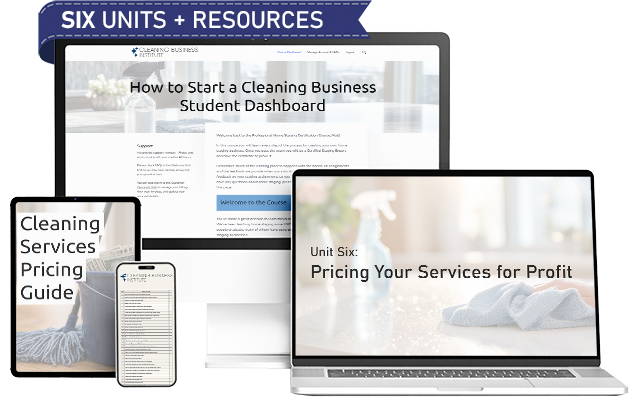
The Fundamentals Course covers insurance where a new owner first meets it. Unit 1, Cleaning Business Foundations, sets the legal basics of structures, licences and insurance alongside a realistic launch budget. Unit 3, Pricing Your Services for Profit, shows how overheads such as premiums belong in every job price.
The insurance that arrives with staff, chiefly workers' compensation, is part of Unit 9, Hiring and Growing Your Team, in the Fast Track Course. If you still need the licence half of the picture, read what licensed and insured means for a cleaning business, and for bonds in detail see how to get bonded.
Ready to get started?
Our step-by-step courses take you from where you are now to a credential you can show, with templates, an online exam, and a 30-day money-back guarantee.
See the courses