Licensed and Insured, What It Means for a Cleaning Business
When a client asks whether a cleaning business is licensed and insured, they want to know two things. Is the business registered to operate where it works, and will an insurer pay if a cleaner breaks something or someone gets hurt? For most cleaners, the honest yes rests on a local licence or registration, a general liability policy, and a certificate proving it.
There is generally no state licence written specifically for cleaning, which surprises many new owners. The licence half is ordinary business registration, and it varies by city and county. The insurance half is where clients look hardest, and it is the half a new owner can prove on paper within a few days.
What clients mean by licensed and insured
The phrase is shorthand, and clients rarely know the legal detail behind it. What they want is reassurance that the person walking into their home or office runs a real business, not a side arrangement that disappears when something goes wrong.
That is why the same few words keep coming up together in quotes and on websites. Each one answers a different worry, and a new owner should know which is which before using any of them in marketing.
- Licensed
- The business holds whatever local licence or registration its city, county or state requires to trade there.
- Insured
- A general liability policy is in force, covering damage to a client's property and injuries to other people caused by the work.
- Bonded
- A janitorial bond is in place, which can reimburse a client if an employee is convicted of theft from them.
- Workers covered
- Employees are protected by workers' compensation, so an injured cleaner's medical bills do not land on the client or the owner.
Clients treat the first two as the minimum. Bonding and workers' compensation matter more as the business grows, and both are covered further down. For now, the useful point is that "insured" means a specific policy with a specific limit, not a general feeling of being careful.
The licence half, and why it varies by town
Licensing for a cleaning business is mostly about the business, not the cleaning. Your city or county wants to know you exist, where you operate from and how to tax you. The Small Business Administration's guide to licences and permits makes the same point, that most requirements are set locally.
In practice the licence half usually involves four pieces of paperwork, and the exact list depends on where you live:
- A business structure, either a sole proprietorship by default or an LLC filed with your state.
- A business name registration, often called a DBA, if you trade under a name other than your own.
- A local business licence or tax registration from your city or county.
- A state sales-tax registration, only in the states that tax cleaning services.
Some cities also want a home occupation permit when the business runs from a residence. Because these rules change at every county line, check your own city and state websites rather than trusting a national list. Our guide to which licences a cleaning business needs explains why the list varies, and the step-by-step application is in how to get a cleaning business license.
One federal step sits alongside the local ones. An Employer Identification Number from the IRS is free, takes minutes online, and most banks and insurers ask for it. The IRS EIN application page is the only place you need to apply, so ignore any site that charges a fee for it.
The insurance half, and the policy clients check
The policy behind the word "insured" is general liability insurance. It pays for damage to a client's property and for injuries to other people caused by your work, such as a guest slipping on a floor you have just mopped. It also pays for a lawyer if someone sues over either.
Commercial clients often ask for a particular limit, and the most common request is $1 million per occurrence with a $2 million aggregate. "Per occurrence" is the most the policy pays for one incident, and "aggregate" is the most it pays in a policy year. Residential clients rarely ask for a number, but they do ask whether you have cover.
The Small Business Administration's business insurance guide lists the other policies small businesses commonly carry. For a cleaner, the ones that come up most are commercial auto for a work vehicle and tools and equipment cover for kit kept in it. What each costs, and what pushes the price up, is the subject of our guide to cleaning business insurance cost.
The order to get licensed and insured in
The two halves depend on each other. An insurer will ask for your business name, structure and often your EIN, and a city licence office may ask for proof of insurance. Doing the steps in order avoids filling in the same form twice.
- 1
Choose the structure and name
Decide between a sole proprietorship and an LLC, then register the trading name if it differs from yours.
Hands on a legal business name - 2
Get an EIN
Apply free on the IRS site. It takes one sitting.
Hands on a federal tax number - 3
Apply for local licences
File with your city or county, and register for sales tax if your state taxes cleaning.
Hands on a licence number - 4
Buy general liability cover
Compare at least three quotes for the services you actually offer.
Hands on a policy number and limits - 5
Request certificates
Ask the insurer for a certificate of insurance to send to clients who want one.
A new owner can usually finish all five within a couple of weeks, with the local licence usually the slowest. The cleaning business startup checklist puts these steps alongside the rest of a launch, so nothing gets missed while you wait on the city.
How to prove it when a client asks
Saying "licensed and insured" on a website costs nothing, which is why careful clients ask to see proof. The proof for insurance is a certificate of insurance, often shortened to COI. It is a one-page summary from your insurer showing the policy, the dates and the limits.
Commercial clients often go one step further and ask to be named as an additional insured. That means the client is added to your policy for claims arising from your work at their site. Many insurers issue these certificates quickly, so ask yours how to request one before the first commercial bid.
A client reading a certificate usually checks a short list of things, and it helps to check them yourself first:
| On the certificate | What the client is checking |
|---|---|
| Named insured | It matches the business name on your quote |
| Policy dates | Cover runs through the contract period |
| Limits | Per occurrence and aggregate meet their minimum |
| Certificate holder | Their company is listed, and added as insured if asked |
The licence half is easier to prove. Keep a scan of your business licence and any state registration with your certificate, so you can send all of it in one email. A client who gets the full set the same day reads it as a sign of how the rest of the work will go.
Where bonding and workers' compensation fit
Bonding is the word that most often follows "licensed and insured" in a client's question. A janitorial bond is not a legal requirement in most places. It is a client expectation, especially in commercial work and in homes where cleaners hold keys.
A bond is cheap next to the trust it buys, and owners tend to settle on similar amounts.
Here at the Cleaning Business Institute, we've found that more than half of the owners we work with who take out a janitorial bond choose the $10,000 size, and that has held over the past two years. How bonds work and how to buy one is covered in our guide to getting bonded for a cleaning business.
Workers' compensation is different, because it is a legal requirement rather than a client preference. Most states require it once you have employees, though the trigger and the exemptions vary by state. A solo owner usually does not need it, but the day the first employee starts, check your state's workers' compensation agency before they set foot on a job.
How the course covers licensing and insurance
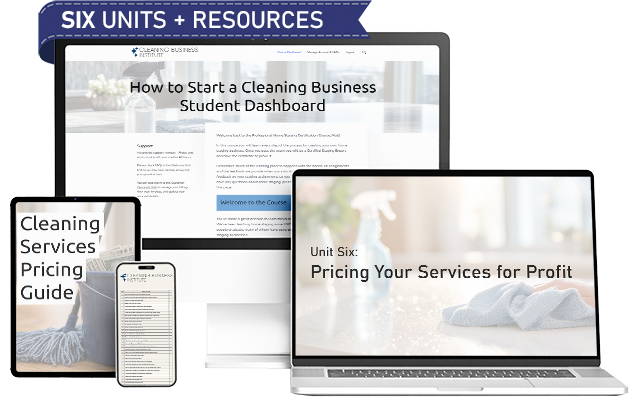
The Fundamentals Course covers this ground in its first two units. Unit 1, Cleaning Business Foundations, sets out the legal basics of business structures, licences and insurance. Unit 2, Setting Up Your Business, walks through registering the name, getting permits, choosing a structure and opening the business bank account.
Workers' compensation and the insurance questions that come with a team belong to Unit 9, Hiring and Growing Your Team, which is in the Fast Track Course. If you have not yet registered the business at all, start with how to register a cleaning business and come back to the insurance steps once you have a name and an EIN.
Ready to get started?
Our step-by-step courses take you from where you are now to a credential you can show, with templates, an online exam, and a 30-day money-back guarantee.
See the courses