How to Get a Cleaning Business License, Step by Step

To get a cleaning business license, settle your business structure and name first, get a federal tax ID if you need one, then apply to your city or county licensing office with those details, and register for sales tax if your state taxes cleaning. Most owners can finish the round in one to two weeks, and most of that time is waiting for approvals.
The order matters more than any single form. A city application asks for the business's legal name and often its tax ID, so filing it first usually means filing it twice. This guide walks through each application in the order that avoids that.
Find out which licenses apply before you file
Everything below assumes you already know which registrations your address needs. That list varies by city, county and state, and our guide to cleaning business license requirements explains which ones usually apply and why.
The short version is that there is rarely a license named for cleaning. What a city calls a business license, a county may call a business tax certificate, and a few places issue nothing at all to a home-based sole proprietor. A ten-minute search of the city and county websites, and a phone call if the pages are unclear, is the real first step.
The application sequence, step by step
Once the list is known, the applications follow a fixed logic. Each step produces something the next one asks for, which is why the order below rarely changes from state to state.
- 1
Choose the structure
Decide between sole proprietor and LLC, and file the LLC with the state if that is the choice.
Hands on the legal name of the business - 2
Register a trade name
File a DBA if the business will trade under a name other than its legal one.
Hands on the name clients will see - 3
Get an EIN
Apply to the IRS online if the business needs a federal tax ID.
Hands on the number most forms ask for - 4
Apply for the local license
Submit the city or county application with the name, structure and tax ID.
Hands on permission to trade there - 5
Register for state tax
Open a sales tax account where cleaning is taxable, and payroll accounts once hiring.
The first three steps set the identity of the business, and the last two use it. Here is what each one involves in practice.
Choose the structure
A sole proprietorship needs no state filing, so an owner who starts that way can move straight on. An LLC is formed by filing articles of organization with the Secretary of State, and the license application will then be made in the LLC's name rather than the owner's.
That is why the structure decision comes first. Changing it after the license is issued usually means updating or reapplying for the license under the new entity. Our guide to forming an LLC for a cleaning business covers the choice itself.
Register a trade name
A DBA ("doing business as") filing registers a name other than the owner's legal name or the LLC's registered name. Depending on the state, it is filed with the county clerk or the state. Licensing offices usually want to see it, because the license should show the name the business trades under.
Choosing and checking the name is covered in our guide on how to register a cleaning business. If a name is still undecided, the cleaning business name generator gives a starting list to check for availability.
Get an EIN
An Employer Identification Number is the business's federal tax ID. The IRS issues it free through its online EIN application, and the number arrives as soon as the application is complete.
A sole proprietor with no employees can often use a Social Security number instead. Many still get an EIN, because it keeps that number off invoices and client paperwork, and because banks commonly ask for one.
Apply for the local license
This is the step most people mean by getting a cleaning business license. Most cities now take applications online, and the form is usually short.
Expect it to ask for the following, so it helps to have them ready before starting.
- The legal business name, any DBA, and the business structure.
- The EIN, or the owner's Social Security number for a sole proprietor without one.
- A business address, which for a home-based owner is usually the home address.
- A short description of the work, such as residential and commercial cleaning.
- The expected number of employees, and sometimes an estimate of gross receipts.
- Proof of any zoning approval, such as a home occupation permit.
Fees are set locally and some cities base them on revenue, so check the fee schedule on the city's own site. Approval can be same-day or take a few weeks, and the license is normally renewed each year.
The waiting time is still useful. While the application is with the city, an owner can get insurance quotes, open the business bank account with the EIN and formation papers, and set up a price list. What should wait is paid work inside that city, since trading before the license is issued is what most local penalties are for.
Register for state tax
Where a state taxes cleaning services, the business registers with the state revenue department for a sales tax permit before charging for taxable work. A business with employees also opens state withholding and unemployment insurance accounts. The Small Business Administration's guide to tax ID numbers explains how the federal and state numbers relate.
Working in more than one city
The single most common gap in a cleaner's licensing is a second city. A license from the city where the business is based may not cover work in the next town, because many cities require a license from any business that works within their limits.
This tends to surface as the client list spreads, and it is part of why owners find the paperwork harder than the cleaning. Across the students we work with at the Cleaning Business Institute, about one in four say keeping up with licenses and registrations was one of the hardest parts of running the business over the past two years.
The fix is simple once it is known. Keep a list of every town with a regular client, check each one's licensing rule when a client in a new town signs, and add the license before the first visit rather than after a letter arrives.
Mistakes that slow the process down
Most delays come from small errors rather than from the licensing office. These are the ones that recur.
- Applying before the name is settled. A license issued to the owner's name has to be amended when the DBA or LLC follows.
- Paying a service for the EIN. The IRS issues it free, and third-party sites that charge for it add nothing.
- Skipping the zoning question. Some cities will not issue a license to a home-based business until zoning has signed off.
- Charging before the sales tax permit. Tax due on early invoices still has to be paid, usually out of the owner's pocket.
- Missing the renewal. Most local licenses expire each year, and late renewal can carry a penalty.
A calendar reminder a month before each renewal date avoids the last one. The cleaning business startup checklist keeps the whole sequence, with space to note each license number and renewal date.
What comes after the license
A license lets the business trade, but clients look for two more things before they hand over a key. Neither is a license, and in most places neither is legally required, yet commercial clients often write both into contracts.
General liability insurance covers accidental damage and injury, and a janitorial bond reimburses a client if an employee steals. Our guides to cleaning business insurance and getting bonded cover each. The general advice from the Small Business Administration's licensing guide applies throughout, which is to confirm every requirement with the state, county and city that set it.
Learning the full setup in the course
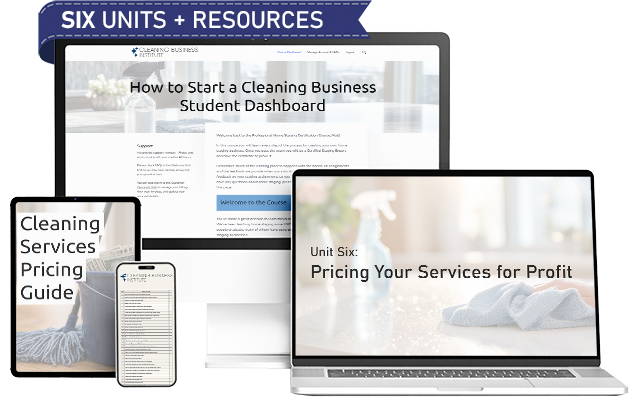
Licensing is one part of a wider setup taught in Unit 2 of the course, Setting Up Your Business. It covers registering a business name and obtaining permits, choosing a structure, opening a business bank account, and the bookkeeping and client policies that make the business run properly once it is licensed.
Unit 2 sits in the Fundamentals Course, alongside Unit 1's grounding in the legal basics and the units on pricing and finding first clients. The Fast Track Course adds four later units, including hiring, where payroll registration becomes part of the job.
Ready to get started?
Our step-by-step courses take you from where you are now to a credential you can show, with templates, an online exam, and a 30-day money-back guarantee.
See the courses