Cleaning Business License Requirements, and Why They Vary
There is no single cleaning business license in most of the United States. A standard house or office cleaning business usually needs a local business license from its city or county, a state registration if it forms an LLC or trades under a brand name, a federal tax ID in many cases, and sales tax registration in the states that tax cleaning.
That is the general shape, and it varies because each layer is set by a different government. The city decides who may trade inside its limits, the state decides how businesses are formed and taxed, and the federal government only steps in for tax IDs and a few specialty services. Insurance and bonding sit alongside all of this, but they are not licenses.
Why there is no single cleaning license
Many trades have a state board. Electricians, plumbers and cosmetologists sit exams and hold a license that names their trade. Ordinary cleaning has no equivalent in most states, so nobody issues a "cleaning license" as such.
What people mean by the phrase is the set of general registrations that every small business needs, applied to a cleaning business.
The Small Business Administration's licensing guide puts it plainly: states regulate a wider range of activities than the federal government, and local governments set their own registration and permit rules. So the list for a cleaner in Phoenix will not match the list for a cleaner in Philadelphia.
The layers are easier to keep straight when they are laid side by side.
| Layer | What it usually covers | Where to check |
|---|---|---|
| City or county | General business license, home occupation permit | City clerk or licensing office |
| State | LLC filing, trade name, sales tax, payroll accounts | Secretary of State and revenue department |
| Federal | Employer Identification Number, employee paperwork | The IRS |
| Specialty | Extra training or licenses for some niches | The agency that regulates that work |
Most new owners only touch the first three rows. The fourth matters only if the business moves into work that carries its own rules, which is covered further down.
The registrations most cleaning businesses need
In practice, a typical residential or commercial cleaning business ends up with four or five registrations. Not every one applies to every owner, and the reasons are worth knowing before filling in a form.
A local business license
This is the closest thing to a cleaning business license, and most cities and many counties require one. It is permission to trade within that jurisdiction, renewed each year, and the application is usually short. Some cities require a license only from businesses based there, while others want one from any business that works inside their limits.
That second rule catches cleaners who serve several towns. A business based in one suburb with clients in three others may need to check four sets of rules. Working from home can add a home occupation permit, which is a zoning approval rather than a license, and our guide to running a cleaning business from home covers what that permit usually asks.
State registration and a business name
A sole proprietor trading under their own legal name often has nothing to file with the state. The moment the business uses a brand name, or forms an LLC or corporation, a state or county filing follows.
The details of that step belong to our guide on how to register a cleaning business, and the choice of structure has its own guide on forming an LLC for a cleaning business.
A federal tax ID
An Employer Identification Number (EIN) is the business's tax ID with the IRS. A sole proprietor with no staff can often use a Social Security number instead, but an owner who hires, forms a multi-member LLC, or wants a business bank account will usually need one.
The IRS issues it free through its online EIN application, and there is no reason to pay anyone else to do it.
Sales tax, in the states that tax cleaning
This is the registration new owners most often miss, because it depends on the state and sometimes on the type of client. Most states do not tax ordinary house cleaning, but some do tax cleaning services, and a few tax commercial work while leaving homes alone.
Texas is a clear example of why the state's own site is the only safe source. The Texas Comptroller's guide to cleaning and janitorial services says tax is due on charges to clean homes, offices and other buildings, and that a maid or janitorial service should hold a sales tax permit.
Another state may say the opposite, so check your own revenue department before quoting a price.
When the work itself needs a license
Ordinary cleaning carries no trade license, but some niches do bring extra rules. A business moving into any of these should check with the agency that regulates that work before taking the first job.
- Biohazard and crime scene cleaning. Federal workplace rules on bloodborne pathogens apply to staff exposed to blood, and some states add their own registration.
- Pool cleaning. Handling and dosing pool chemicals is regulated differently from state to state, which our guide to starting a pool cleaning business covers.
- Pest treatment. Applying pesticides for a client, as opposed to cleaning, usually needs a state applicator license.
- Pressure washing and outdoor work. Some places regulate where wash water may go, and a few treat certain exterior work as contracting.
None of these affects a business that cleans homes and offices with ordinary products. They matter when an owner adds a service because a client asked, without checking whether the new work changes the rules.
What licensing does not include
Clients often ask whether a cleaner is "licensed, bonded and insured", and the phrase blurs three different things. A license is permission from a government. Insurance and bonding are private contracts, and in most places neither is a legal requirement for a cleaning business.
Clients expect both all the same, and commercial clients often write them into contracts. General liability insurance covers accidental damage and injury, while a janitorial bond reimburses a client if an employee steals. Our guides on cleaning business insurance and getting bonded explain each one, and the guide to being licensed and insured explains how to present the full set to clients.
Workers' compensation is the exception. Once a business has employees, most states require it by law, and it is set up through the state or a private insurer depending on where the business is based.
How structure and staff change the list
So far this has described a solo owner. The list grows in two predictable places, when the business forms an entity and when it hires, and planning for both from the start saves filing twice.
Here at the Cleaning Business Institute, we've found that about four in five of our students launch as solo operators with no staff, a share that has held steady over the past two years.
For those owners, the first year usually means a local license, a name filing and perhaps an EIN, with nothing more until the first hire.
The changes are easier to see as a short sequence.
- Solo, own name
- Local business license, plus sales tax registration where the state taxes cleaning.
- Brand name or LLC
- Adds a trade name or LLC filing, an EIN, and any annual state report the entity owes.
- First employee
- Adds state payroll and unemployment accounts, workers' compensation and federal employer filings.
The step from solo to employer is the largest of the three, and it arrives later for most owners. Hiring brings its own questions about employees and contractors, which our guide on hiring cleaners covers.
Checking the rules for your own area
Because every layer varies, the only reliable list is the one built for a specific address. A short round of checks, done in this order, turns a general picture into a local one.
- Search the city's website for its business license page, then the county's, and note whether either licenses businesses that only work there.
- Read the Secretary of State's business section for name and entity filings.
- Check the state revenue department for whether cleaning services are taxable.
- If working from home, ask the zoning office whether a home occupation permit applies.
- Repeat the city check for every town with regular clients.
Once the list is known, the filing itself is mostly forms and small fees. Our guide on how to get a cleaning business license walks through the applications in order, and the cleaning business startup checklist keeps the steps in one place.
Where the course covers licensing and setup
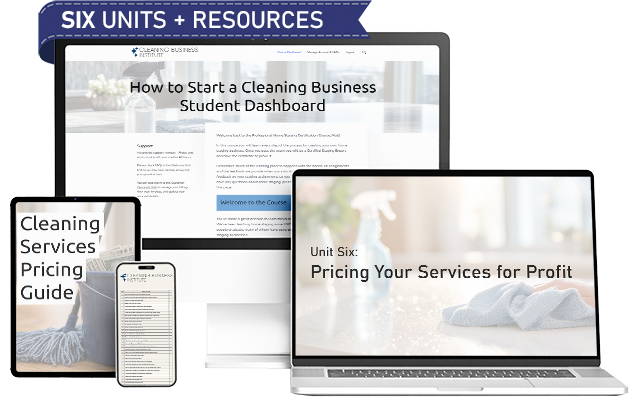
The legal side of starting is taught across two units of the course. Unit 1, Cleaning Business Foundations, covers the legal basics of structures, licenses and insurance as part of planning the launch. Unit 2, Setting Up Your Business, covers registering a name, obtaining permits, choosing a structure, and the banking and bookkeeping that follow.
Both units are in the Fundamentals Course, which covers units 1 to 6. The Fast Track Course includes them too, along with the later units on hiring and scaling, where payroll registration and workers' compensation become part of the work.
Ready to get started?
Our step-by-step courses take you from where you are now to a credential you can show, with templates, an online exam, and a 30-day money-back guarantee.
See the courses