How to Start a Cleaning Business in California

To start a cleaning business in California, choose between a sole proprietorship and an LLC, file a fictitious business name with your county if you use a brand name, and get your city's business license or tax certificate. Cleaning services carry no California sales tax, but an LLC owes an $800 annual tax, and workers' compensation is required from the first employee.
Commercial cleaners have one more step that most states do not ask for. A business doing janitorial work with even one worker must register with the state Labor Commissioner every year. This guide takes each requirement in turn and links the California agency that sets it.
Choosing a structure, and the $800 question
In most states the choice between a sole proprietorship and an LLC turns on liability and paperwork. In California it also turns on a fixed yearly cost. The Franchise Tax Board's LLC page says every LLC doing business or organized in California must pay an annual tax of $800, even in a year with no business.
The first payment is due by the 15th day of the fourth month after the LLC is filed with the Secretary of State. An LLC with more than $250,000 of California income also pays a separate fee on a sliding scale, which starts at $900.
For a new owner cleaning a handful of homes, $800 is a meaningful share of the first year's profit. That is why many California cleaners start as sole proprietors and form an LLC once the business is steady. Our guide to forming an LLC for a cleaning business sets out when the protection is worth the cost.
The fictitious business name statement
A sole proprietor trading under a name other than their own, such as "Bay Area Fresh Cleaning", files a fictitious business name statement with the county clerk where the business is based. The statement must then be published in a local newspaper, and the clerk's office can explain the timing and cost.
City business licenses and tax certificates
The local layer comes next. Many California cities require every business operating inside their limits to hold a business license or a business tax registration certificate, and some charge it on gross receipts rather than as a flat fee.
The rules differ from city to city, and a cleaner serving several cities may owe something in more than one. A home-based business may also need a home occupation permit from the planning department. The city's own website is the only reliable source here, because no state agency keeps a single list.
Sales tax and California cleaning services
This part is simpler than in many states. The California Department of Tax and Fee Administration says that when no merchandise changes hands there is no sale under California sales and use tax law, so a business that provides only services does not collect sales tax.
House cleaning, office cleaning and janitorial contracts are services, so none of them is taxed. The exception is a cleaner who also sells goods, such as cleaning products to clients, who would need a seller's permit for those sales.
The janitorial registration commercial cleaners need
California's Property Service Workers Protection Act sets a registration rule written specifically for janitorial work. The Labor Commissioner's page for janitorial providers says any business that employs at least one janitor, or engages one through a contract, subcontract or franchise, must register.
The definition of a covered worker is wide. It includes employees, independent contractors and franchisees who work mainly as janitors, so calling a cleaner a contractor does not avoid the rule. The page also lists who does not need to register, and residential cleaners are on that list.
That makes the residential and commercial paths in California quite different, as the table shows.
| Rule | Cleans homes only | Cleans commercial buildings |
|---|---|---|
| Janitorial registration | Not required | Required with one covered worker, $500 a year |
| Harassment prevention training | Not under this act | In person, every two years |
| Workers' compensation | Required from the first employee | Required from the first employee |
The registration costs a nonrefundable $500 and must be renewed every year, also for $500. Registered employers keep detailed records for three years, including each worker's daily hours and pay, and anyone who contracts with an unregistered janitorial employer can be fined as well.
Employees, contractors and workers' compensation
California is strict about who counts as an employee. Under the state's ABC test, a worker is presumed to be an employee unless the business can show they are free from its control, do work outside its usual business, and run an independent trade of their own. A cleaner who cleans for a cleaning company rarely passes the second part.
Once there is an employee, insurance follows immediately. The Division of Workers' Compensation says California employers must carry workers' compensation even if they have only one employee. There is no small-business threshold, unlike Florida or North Carolina.
Wages and pricing
The state minimum wage is $16.90 an hour in 2026, and several cities and counties set higher local minimums. Those wages shape what a California cleaning business must charge once it hires.
Here at the Cleaning Business Institute, we've found that the hourly rate our California students build into a standard house clean has run at about three times the state minimum wage over the past two years. The cleaning price calculator shows how a rate like that turns into a price per visit.
Where the cleaning work is in California
California's size means the markets differ more within the state than between many states. Most new California cleaning businesses build around one of these.
- Recurring house cleaning in high-cost metro areas, where clients expect a polished booking and payment process.
- Move-out cleaning for renters and property managers in markets with high tenant turnover.
- Vacation rental turnovers along the coast and in mountain and desert resort areas.
- Office cleaning, which brings the janitorial registration and training rules above.
Starting residential and adding commercial work later is a common route in California, because it delays the registration fee and the training obligation until the business can carry them.
The difference is easiest to see in the fixed state costs alone. Here is an illustration for an LLC with one employee that takes on its first office contract, leaving out insurance premiums and city fees, which vary.
The commercial LLC needs $1,300 of profit each year just to cover these two charges, about $108 a month.
That $1,300 is not a reason to avoid commercial work, which often brings steadier income than homes. It is a reason to price the first office contract with those charges already spread across the year.
Putting the California steps in order
The steps build on each other, so the order matters. A new California cleaning business usually works through them like this.
- Choose a structure, then form an LLC or file a fictitious business name statement with the county.
- Get the city business license or tax certificate, plus any home occupation permit.
- Get an EIN from the IRS and register with the Employment Development Department as an employer before the first payroll.
- Buy workers' compensation before the first employee starts.
- Register with the Labor Commissioner before taking on commercial janitorial work with any worker.
The general version of these steps is in our guide on how to start a cleaning business, and the national picture is in our guide to what licenses a cleaning business needs. The startup cost calculator totals the fees for a first year.
Where the course covers starting in California
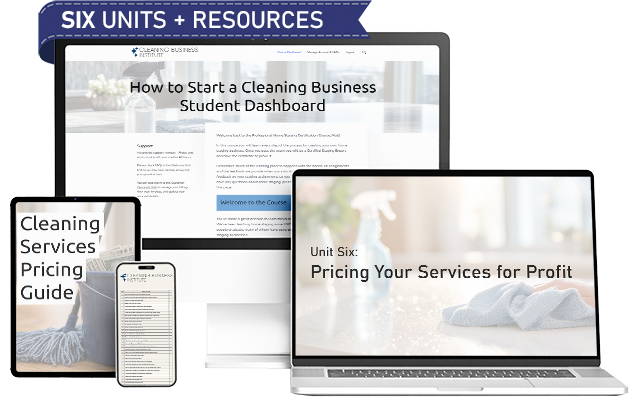
California rewards owners who set up carefully from the start. Unit 1, Cleaning Business Foundations, covers business structures, licenses and insurance, and Unit 2, Setting Up Your Business, covers registering a name, permits and bookkeeping. Both are in the Fundamentals Course.
The employee and contractor question belongs to Unit 9, Hiring and Growing Your Team, and moving into commercial contracts belongs to Unit 10, Scaling and Long-Term Growth. Those units are in the Fast Track Course, which includes all ten.
Ready to get started?
Our step-by-step courses take you from where you are now to a credential you can show, with templates, an online exam, and a 30-day money-back guarantee.
See the courses