How to Start a Cleaning Business in Texas
To start a cleaning business in Texas, file an assumed name certificate if you trade under a brand name, get a sales tax permit from the Texas Comptroller, and check your city's zoning rules for a home-based business. Texas has no general business license, but it taxes house cleaning as well as office cleaning, which surprises most new owners.
Workers' compensation is the other Texas difference. Private employers may choose not to carry it, and that choice comes with obligations of its own. The rest of this guide takes each step in turn, with the state's own sources for each.
Texas has no general business license
Many states expect every business to hold a general license. Texas does not. The Office of the Governor's guide to starting a business says plainly that a general business license is not required in Texas, while warning that particular activities may need their own permits.
For ordinary house and office cleaning, that leaves local rules as the main thing to check. A home-based business may fall under a city's zoning rules on parking, signs or customer visits, and some homeowners' associations restrict business vehicles. A call to the city's planning or permits office settles it.
Registering the business name in Texas
Texas calls a brand name an assumed name, and where it is filed depends on the structure. A sole proprietor files an assumed name certificate with the county clerk in each county where the business keeps an office, and that certificate must be notarized.
An LLC or corporation files its assumed name with the Secretary of State instead, and since 2019 it no longer files with the county as well. A certificate can run for up to ten years before it must be renewed.
An LLC also brings the Texas franchise tax. The no-tax-due threshold is $2.65 million in revenue for the 2026 and 2027 reports, far above a new cleaning business, but the LLC still files a report by May 15 each year. Our guide to forming an LLC for a cleaning business weighs whether the structure is worth it.
Income tax is simpler here than in most states. Texas has no personal income tax, so a sole proprietor or single-member LLC owner pays federal income and self-employment tax on the profit and nothing to the state on it. That leaves sales tax as the one state tax most new cleaning owners deal with every month or quarter.
Why Texas cleaners collect sales tax on house cleaning
This is the rule that separates Texas from most of the country. The Comptroller's guide to cleaning and janitorial services says tax is due on the charge to clean a home, office, warehouse, restaurant or any other building, and that a maid or janitorial service should hold a sales tax permit.
There is one narrow exception. A self-employed person who does traditional housekeeping as an employee of the household owes no tax, but the exception ends the moment that person works as a subcontractor for a maid service. A cleaning business with its own name, clients and pricing should assume its work is taxable.
The rate and what it applies to
The Texas sales and use tax is 6.25 percent at the state level, and cities, counties, transit authorities and special districts can add up to 2 percent more. The combined rate can reach 8.25 percent, and the Comptroller's rate locator gives the exact figure for any address.
The guide also lists services that new owners often assume are exempt. These are all taxable in Texas.
- Washing windows, floors, walls and ceilings as part of a cleaning visit.
- Cleaning chimneys and air ducts.
- Pressure washing buildings, sidewalks and parking lots.
- Swimming pool maintenance, at homes as well as businesses.
- Picking up trash indoors or outdoors.
How the tax changes a quote
Because house cleaning is taxable, every residential price needs a decision about whether tax is added on top or included. Here is how that plays out on a $160 clean in a city at the full 8.25 percent. The figures are an illustration.
Quoting tax-inclusive by accident costs this owner $12.19 on every visit, or about $634 a year for one weekly client.
Either approach is legal as long as the tax is collected and paid. The mistake is quoting a round number, forgetting the tax, and paying it out of the margin. The cleaning price calculator sets the base price, and the tax goes on top.
Supplies, resale certificates and subcontracting
Texas has one rule that works in the cleaner's favor. Supplies used up in the work, such as cleaners and equipment, are taxed when bought. But items handed over to the client as part of a taxable service, such as toilet paper, paper towels and hand soap left in an office restroom, can be bought with a resale certificate instead.
The same logic covers subcontracting. A business that hires another cleaning company to do some of its jobs can give that company a resale certificate, then collect tax from its own client on the full charge.
Workers' compensation is a choice in Texas
Texas is the one state where most private employers may opt out of workers' compensation. The Texas Department of Insurance's employer resources say coverage is not required in most cases, and that employers who go without it are called non-subscribers.
Opting out is not the same as doing nothing. A non-subscriber must report to the state that it has no coverage, notify its employees, and report serious work injuries to the Division of Workers' Compensation. It also loses the limits on liability that coverage brings, so an injured employee can sue the business.
Across the Texas students we work with at the Cleaning Business Institute, about one in four who have made a first hire over the past two years started without workers' compensation. Commercial contracts often ask for a certificate of coverage, which is a common reason to add it later.
Cleaning work involves ladders, wet floors and chemicals, so the decision deserves more than a glance at the premium. Our guide to cleaning business insurance covers the policies clients expect regardless of the state.
Where the cleaning work is in Texas
Texas has several large metro areas rather than one center, and each supports a different mix of work. Most new Texas cleaning businesses start in one of these.
- Recurring house cleaning in the suburbs of the large metros, priced with tax added.
- Move-in and post-construction cleans in the new subdivisions around the growing metros.
- Office and medical cleaning, where clients are used to paying tax on janitorial invoices.
- Short-term rental turnovers in tourist and event areas.
Post-construction work is worth a closer look before quoting. The Comptroller says building cleaning bought by a homebuilder as part of a new residential structure is not taxable, so the same clean can be taxable for a homeowner and nontaxable for the builder.
Putting the Texas steps in order
The filings are few, and the order is simple. A new Texas cleaning business usually works through them like this.
- Choose a structure, and file an LLC or an assumed name certificate.
- Check city zoning and any homeowners' association rules for a home-based business.
- Get a sales tax permit from the Comptroller before the first paid job.
- Get an EIN from the IRS if hiring or forming a multi-member LLC.
- Buy general liability insurance, and decide on workers' compensation before the first hire.
The general version of these steps is in our guide on how to start a cleaning business, and the national picture is in our guide to what licenses a cleaning business needs. The startup cost calculator adds up the fees and supplies.
Where the course covers starting in Texas
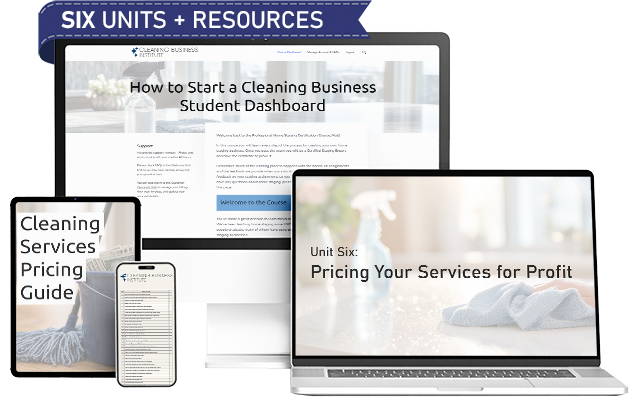
Two parts of the course do most of the work for a Texas owner. Unit 2, Setting Up Your Business, covers registering a name, choosing a structure and setting up bookkeeping that tracks tax collected separately from income. Unit 3, Pricing Your Services for Profit, covers building a price that holds up once tax is added.
Both are in the Fundamentals Course. The workers' compensation decision belongs to Unit 9, Hiring and Growing Your Team, which is in the Fast Track Course along with all ten units.
Ready to get started?
Our step-by-step courses take you from where you are now to a credential you can show, with templates, an online exam, and a 30-day money-back guarantee.
See the courses