How to Start a Cleaning Business in North Carolina
To start a cleaning business in NC, file an assumed business name certificate with your county's register of deeds if you trade under a brand name, or form an LLC with the North Carolina Secretary of State. House, office and janitorial cleaning carry no North Carolina sales tax, and workers' compensation becomes compulsory at three regular employees.
That makes North Carolina one of the lighter states to start in, with two exceptions worth knowing early. Pool cleaning is taxed, and any service missing from the state's list of exempt cleaning work is taxable by default. This guide takes each requirement in turn and links the North Carolina agency behind it.
Registering a business name in North Carolina
North Carolina handles brand names at county level. The Secretary of State's guidance on assumed business names says a business trading under any name other than the owner's legal name files an assumed business name certificate with the register of deeds.
The filing reaches further than it once did. Since December 1, 2017, one certificate can cover several counties or all 100, which suits a cleaner whose clients sit across county lines. Each certificate is also uploaded to a statewide database kept by the Secretary of State.
An owner forming an LLC files with the Secretary of State instead, and the state's business registration manual walks through that filing. Our guide to forming an LLC for a cleaning business helps decide whether the structure is worth it in year one.
Local licenses after the privilege tax repeal
Older advice about North Carolina often mentions a city privilege license. That tax was repealed by the General Assembly with effect from July 1, 2015, so cities no longer charge cleaning businesses a general license tax just for trading.
Local rules still apply in other forms. Zoning controls what a home-based business may do, including parking, signs and client visits, and some homeowners' associations limit business vehicles. A call to the city or county planning office settles what applies at a given address.
Which cleaning services North Carolina taxes
North Carolina starts from the opposite end to most states. The Department of Revenue treats services to real property as taxable repair, maintenance and installation work unless a specific exemption applies, and then lists the cleaning services that are exempt.
The Department of Revenue's taxability chart for services to real property covers the work a cleaning business is most likely to offer. Its cleaning section reads like this.
| Exempt | Taxable |
|---|---|
| Custodial, janitorial and maid services | Pool cleaning |
| Carpet cleaning, including stains | Fish tank and aquatic feature cleaning |
| Window washing | Power washing a pool |
| Power washing buildings, decks and driveways | Area rugs, which the carpet exemption excludes |
| Gutter, duct and dryer vent cleaning | Unlisted services to real property, by default |
The right-hand column matters for anyone planning add-on services. A house cleaner who starts servicing a client's pool takes on a sales tax obligation for that work, and rug cleaning needs checking before it is quoted.
A business that does take on taxable work registers with the Department of Revenue for sales and use tax before the first taxable job, then files returns on the schedule the department assigns. One that sticks to the exempt list has nothing to register for, which keeps the first year's paperwork short.
Supplies are a different matter. A cleaning business buying products, vacuums and equipment for its own use pays sales tax on them like any other buyer, so those costs go into each job at their taxed price.
Vacation rentals and the accommodation condition
The exemption for janitorial and maid services has one condition. It applies provided the cleaning is not part of the gross receipts from renting an accommodation, as charged by the host or the rental platform.
In practice, a cleaning fee that guests pay as part of a stay belongs to the taxable rental, which is the host's and platform's concern. A cleaner's own invoice to the host is a separate charge, so a turnover cleaner on the coast or in the mountains is normally billing exempt work.
Anyone unsure should ask the Department of Revenue before collecting tax that may not be owed.
Workers' compensation at three employees
North Carolina sets its threshold lower than Florida and higher than California. The North Carolina Industrial Commission's employer guidance says businesses that regularly employ three or more people must carry workers' compensation insurance or qualify to self-insure.
Who counts is the detail to watch. Corporate officers count toward the three, although they may exclude themselves from the policy. Sole proprietors, partners and LLC members are not counted automatically but may choose to cover themselves.
Below three employees the coverage is optional in law, but commercial clients often ask for it anyway, alongside general liability insurance and a janitorial bond. Our guide to cleaning business insurance explains what each policy covers.
Hiring brings two more state registrations alongside the insurance. An employer registers with the Department of Revenue to withhold state income tax from wages, and with the Division of Employment Security for unemployment insurance. Both are online and are best done before the first payday rather than after it.
The order of hires matters for the count too. A solo LLC member who takes on two employees has two employees for the Act's purposes, not three, so coverage becomes compulsory with the third regular hire. Buying it sooner is a judgment call, since a single uninsured injury can be costly for a small business.
Where the cleaning work is in North Carolina
North Carolina's markets differ sharply from one region to the next. Wages for employed house cleaners show the spread, using the Bureau of Labor Statistics figures published on O*NET.
The Triangle sits well above the rest of the state, and that shows up in hiring.
Here at the Cleaning Business Institute, our North Carolina students hiring in Durham and Chapel Hill have offered cleaners about a fifth more than owners elsewhere in the state over the past two years. That is a cost to build into prices there, rather than a reason to avoid the region.
Regional differences go beyond wages. The coast and the mountains run on tourism, with weekend turnovers and quiet winters, while the large metros offer steadier recurring work. Most new North Carolina cleaning businesses build around one of these markets.
- Recurring house cleaning in the growing suburbs around Charlotte and the Triangle.
- Vacation rental turnovers on the coast and in the mountains, with sharp seasonal peaks.
- Move-out cleaning for landlords near the large university campuses.
- Office and medical cleaning around research parks and hospital systems, where the exemption keeps invoices simple.
Putting the North Carolina steps in order
The filings are short, but they still depend on each other. A new North Carolina cleaning business usually works through them like this.
- Choose a structure, then file an assumed business name certificate or form an LLC.
- Check zoning and any homeowners' association rules for a home-based business.
- Confirm every planned service against the Department of Revenue's chart, and register for sales tax only if one is taxable.
- Get an EIN from the IRS if hiring or forming a multi-member LLC.
- Buy general liability insurance, and add workers' compensation by the third regular employee.
The general version of these steps is in our guide on how to start a cleaning business, and the national picture is in our guide to what licenses a cleaning business needs. The startup cost calculator totals the first year's fees and supplies.
Where the course covers starting in North Carolina
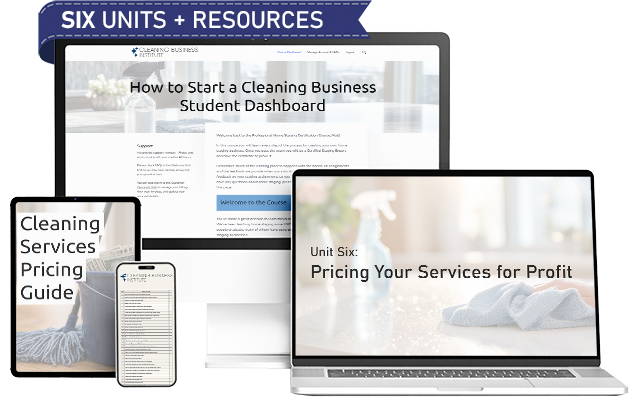
Because North Carolina asks for little paperwork, most of a new owner's effort goes into pricing and finding clients. Unit 1, Cleaning Business Foundations, and Unit 2, Setting Up Your Business, cover the structures and registrations above. Unit 3, Pricing Your Services for Profit, covers setting rates that suit a local wage level like those in the chart.
Unit 6, Getting Your First Clients, covers the launch itself. All four units are in the Fundamentals Course, which covers units 1 to 6.
Ready to get started?
Our step-by-step courses take you from where you are now to a credential you can show, with templates, an online exam, and a 30-day money-back guarantee.
See the courses