How to Hire Cleaners, From the First Ad to Day Ninety
To hire cleaners well, decide first whether the role is an employee or a contractor, then recruit for reliability over experience, vet every candidate with references, a background check and a paid working session, and plan the first 90 days so good people stay. The vetting and the first three months matter most.
Cleaning skill is the easiest part to teach. Turning up on time, telling the truth about a broken vase and following a checklist when nobody is watching are much harder to train. So the whole process is built to test for those, before anyone holds a client's key.
Employee or contractor, and why it is not your choice alone
Many owners would rather pay cleaners as independent contractors, because there is no payroll tax or withholding to handle. The catch is that the label is not yours to pick. It depends on how the work is actually done, and getting it wrong can mean back taxes and penalties.
The IRS guidance on independent contractors and employees looks at three kinds of evidence. Behavioral control asks who decides how the work is done. Financial control asks who supplies tools and how the worker is paid. The type of relationship asks whether the work is ongoing and central to the business.
Here is how those tests tend to land for a typical residential cleaning business. Treat it as a general picture rather than a ruling on any one arrangement.
| Question | Points to employee | Points to contractor |
|---|---|---|
| Schedule and route | You set them | They choose their own days |
| Method and checklist | You set them | They use their own methods |
| Products and equipment | You supply them | They bring their own |
| Who the client books and pays | Your business | Their own business |
| Length of the work | Ongoing and central to you | A defined, one-off job |
A cleaner who works your schedule, to your checklist, with your supplies, cleaning your clients' homes every week, lands in the employee column on every line. That is why most cleaning businesses that hire to a standard end up with employees. Some states apply an even stricter test than the IRS, so check your state labor department's own guidance before deciding.
Where to find cleaners worth interviewing
Once the role is settled, the next question is where candidates come from. Large job boards bring volume, but volume is not the problem most owners have. The problem is finding a handful of reliable people among many who will not turn up to the interview.
These sources tend to produce the best candidates for a small cleaning business:
- Referrals from your current cleaners. Good cleaners usually know other good cleaners, and they rarely recommend someone who will make their own days harder. A small bonus after the new hire's 90th day rewards the referral without paying for no-shows.
- Local job boards and community groups. These reach people who live near your routes, which cuts lateness and drive time.
- Large job boards. These are useful for reach, as long as the ad screens hard.
- People leaving hotel housekeeping or janitorial work. Many want daytime hours and a smaller team.
The ad itself does much of the screening. State the pay range, the hours, whether a driver's licence is needed and that a background check is part of the process. Candidates who would fail any of those tend to skip the ad, which saves everyone a phone call.
How to vet a cleaner before they hold a key
Every cleaner you hire will be alone in clients' homes, so vetting is the most important part of hiring. The steps below run in this order on purpose. Each one is cheaper than the one after it, so weak candidates leave the process before it costs you much.
- 1
Phone screen
Ten minutes on availability, transport, pay expectations and why they want the work.
Hands on a short list worth meeting - 2
Interview
Ask what they did the last time something went wrong on a job, and listen for specifics.
Hands on two or three finalists - 3
References
Call past employers and ask about attendance and whether they would rehire.
Hands on candidates others vouch for - 4
Background check
Run it with written consent, through a screening company, after a conditional offer.
Hands on a candidate cleared to enter homes - 5
Paid working session
A paid shift alongside you or a lead, cleaning a real house to your checklist.
Hands on proof of how they actually work - 6
Supervised start
Several weeks on a team before they clean any home alone.
The paid working session is where most hiring mistakes are caught. In three hours you see whether someone follows the checklist, how they handle a cluttered room and whether they ask before moving a client's things. No interview answer shows that as clearly.
Background checks come with legal duties. Under federal law, a background report from a screening company needs the candidate's written permission, and turning someone down because of it triggers notice steps. The EEOC's guide to background checks sets these out, along with how to treat a criminal record fairly. Some states and cities add their own rules, so check locally too.
Pay, paperwork and the cost of a bad hire
Pay sets who applies and who stays. Look at what local cleaning companies, hotels and janitorial firms offer, and aim at or a little above it. A dollar or two an hour more is usually far cheaper than the turnover that a below-market wage brings.
That turnover is expensive even at a small business. The Society for Human Resource Management puts the average cost of filling a nonexecutive job at $5,475, counting advertising, screening and interview time.
Cleaning firms see a smaller but still painful version. Across the students we work with at the Cleaning Business Institute, owners who tallied it over the past two years found that a cleaner who leaves inside 90 days costs them between $2,000 and $5,000 in ads, interviews, paid training shifts and re-cleans.
Employees also bring paperwork that starts on day one. The IRS page on hiring employees covers the federal basics. These are the items most new employers need:
- An employer identification number and a payroll system that withholds tax.
- A Form W-4 from each employee for income tax withholding.
- A completed Form I-9 for each new hire, which every U.S. employer must keep.
- State new-hire reporting and state payroll tax registration.
- Workers' compensation cover, which most states require once you have employees.
The insurance side deserves its own look before the first hire. The post on cleaning business insurance covers workers' compensation and what changes when staff join.
Keeping good cleaners past the first 90 days
A new cleaner is most likely to leave in the first few months, before they feel part of the business. So retention is mostly about those first 90 days. A new hire who knows what good looks like, gets steady hours and hears about it when they do well is far more likely to stay.
Start with the standard. A written cleaning service checklist means a new cleaner is judged against something they can see, not against the owner's mood. Pair them with your best cleaner for the first weeks, and inspect a sample of their work with them rather than behind their back.
Then keep the hours steady. Cleaners leave businesses where the week changes at short notice, because they cannot plan around it. Grouping each cleaner's jobs by area, as the post on how to scale a cleaning business describes, also cuts the unpaid-feeling drive time they notice most.
Finally, give them somewhere to go. A clear path from cleaner to team lead, with a pay step attached, tells good people the business has room for them. For when to make the first hire at all, read how to grow a cleaning business.
What the course teaches about hiring
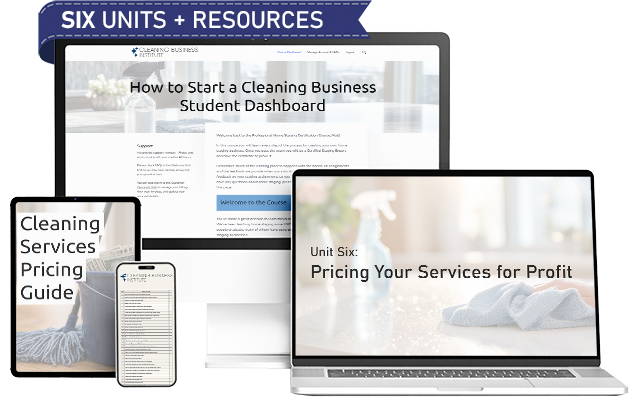
Hiring is covered in Unit 9, Hiring and Growing Your Team, part of the Fast Track Course. It deals with when to hire your first employee or subcontractor, finding and interviewing reliable staff, training to your standard, and vetting a candidate with a paid working session before anybody holds a key.
The standard that new hires are trained to comes from Unit 4, Cleaning Techniques and Standards, which is part of both tiers. An owner who has not yet written down how they clean will find that unit the right place to begin.
Ready to get started?
Our step-by-step courses take you from where you are now to a credential you can show, with templates, an online exam, and a 30-day money-back guarantee.
See the courses