How to Charge for Cleaning Services and Quote Each Job

To charge for cleaning services, work out the hourly rate your business needs, estimate how many hours the job will take, and add what the job costs you in supplies and driving. That gives a floor price for the job. Check it against local prices, then quote a flat price in writing. In the worked example below, a three-bedroom home comes out at $160.
The method matters more than the number, because the number changes with your town and your costs. A rate built this way can be defended when a client pushes back, and it can be adjusted when costs rise. A rate copied from a competitor cannot.
Start with the hourly rate your business needs
Every job price rests on one figure, which is what each billable hour has to earn. A billable hour is an hour spent cleaning for a paying client. Driving, quoting, invoicing and marketing are real work, but no client pays for them directly, so the billable hours have to carry them.
That is why the rate is always higher than it first looks. The ledger below works it out for a solo owner who wants $50,000 a year in profit before tax, using stated assumptions you can replace with your own.
Dividing by 1,920 hours instead of 1,344 would understate the rate by about $12 an hour, which is the cost of the time no client pays for.
The $40 is a floor for this owner, not a market price. It covers overheads and pay, but not the supplies and driving each job uses, which are added per job in the next step. It is also profit before tax, so the owner still has to set aside for income and self-employment tax.
If you plan to hire, the same logic applies with wages in place of your own time. O*NET's profile of maids and housekeeping cleaners gives a median wage of $17.07 an hour, and the rate you charge has to cover that wage, payroll costs and your margin on top.
Turn the hourly rate into a price for one job
Clients rarely want an hourly rate. They want to know what the clean will cost, so most residential cleaners quote a flat price per visit. The hourly rate is how you arrive at that price, not what you show the client.
The steps run in a fixed order, because each one needs the answer from the step before:
- 1
See the space
Walk through it, or get a video call, and note size, condition, pets and anything the client wants added.
Hands on a clear scope - 2
Estimate the hours
Time each room from your own past jobs, and add extra for a first clean.
Hands on an hours figure - 3
Apply your rate and add direct costs
Multiply hours by your hourly rate, then add supplies and the driving for that address.
Hands on a floor price - 4
Check the local market
Compare the floor with what similar homes cost nearby, and round to a clean figure.
Hands on the quoted price - 5
Quote in writing
State what is included, what is not, the price and the payment terms.
Step 2 is where accuracy comes from, and it improves with every job. Time each clean for the first few months and note how long kitchens, bathrooms and bedrooms actually take you. After a dozen jobs, your estimates stop being guesses, and your quotes stop losing money on the homes that took longer than expected.
A worked quote for a three-bedroom home
Here is the method applied to one illustrative job, a first clean of a three-bedroom, two-bathroom home. From the walkthrough, the owner estimates 3.5 hours. At $40 an hour that is $140 of time.
Direct costs come next. Supplies for a clean this size run to about $8 on the owner's own figures, and the home is a 12-mile round trip. At the IRS standard mileage rate of 76 cents a mile, the driving costs $9.12. The floor price is $140 plus $8 plus $9.12, or $157.12.
The driving line is the one that gets missed. Here at the Cleaning Business Institute, we've found over the past two seasons that driving is the cost most often missing from a new owner's first quote, and at 76 cents a mile a 12-mile round trip adds about $9 to the job.
Rounded up, the quote is $160. As a check, the cleaning price calculator suggests a range of $160 to $195 for a standard one-time clean of a three-bedroom, two-bathroom home in an average-cost area. The worked price sits at the bottom of that range, so this owner has room to charge more and no reason to charge less.
Adjusting the price for the kind of clean
The method above handles different jobs without separate rules, because the hours change and the rate stays the same. A deep clean or a move-out clean takes longer, so the price rises with the hours. A recurring clean takes less time than a first clean, so it costs less per visit.
That is a better guide than a fixed multiplier, because homes differ. Still, a few patterns are worth knowing before you estimate hours:
- First cleans take longer than the regular visits that follow, so many cleaners quote the first visit separately.
- Weekly and fortnightly cleans start from a cleaner home each time, so the hours, and the price, come down.
- Deep and move-out cleans add inside appliances, cabinets and baseboards, which can add hours fast.
- Pets, clutter and stairs all add time, and the walkthrough is the moment to notice them.
- Add-ons such as inside the oven or the fridge are easiest to price as fixed extras, each worked out the same way.
Commercial work follows the same principle, though larger spaces are often estimated by square footage. The choice between hourly, flat, per-room and square-foot pricing is covered in our guide to cleaning business pricing models, so this post stays with the single job.
Presenting the price so it holds
A good price can still be lost by the way it is presented. A written quote that lists what is included makes the price look like a product rather than a number to haggle over, and it prevents the "I thought that was included" dispute later.
The cleaning services price list template sets out standard prices and add-ons in one place. For larger or commercial jobs, a fuller cleaning business proposal template gives the scope, schedule and terms room to breathe.
When a client says the price is too high, the hourly rate behind it is what lets you answer calmly. You can offer a smaller scope or a less frequent visit at a lower price, rather than the same work for less. Cutting the price for the same work only teaches the client that the first number was not real.
Review the rate every year
Costs rise, and the mileage rate alone changes during some years. A rate set once and never reviewed shrinks a little in real terms every year. Recalculate the hourly rate at least annually, apply it to new clients straight away, and give existing clients written notice before their price changes.
How the course teaches pricing
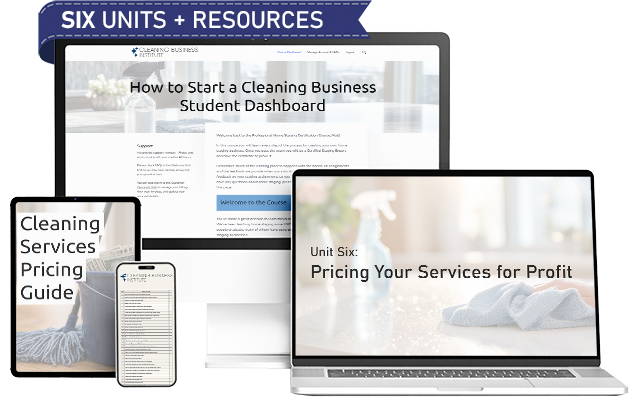
Unit 3 of the Fundamentals Course, Pricing Your Services for Profit, covers this ground in depth. It works through the true cost of running a cleaning business, when to charge hourly, flat-rate or by square footage, pricing packages for different clients, and how to handle price objections with confidence.
Unit 2, Setting Up Your Business, covers the payment and cancellation policies that sit in every quote. If you want to see what a price like this adds up to over a year, read how much a cleaning business makes.
Ready to get started?
Our step-by-step courses take you from where you are now to a credential you can show, with templates, an online exam, and a 30-day money-back guarantee.
See the courses