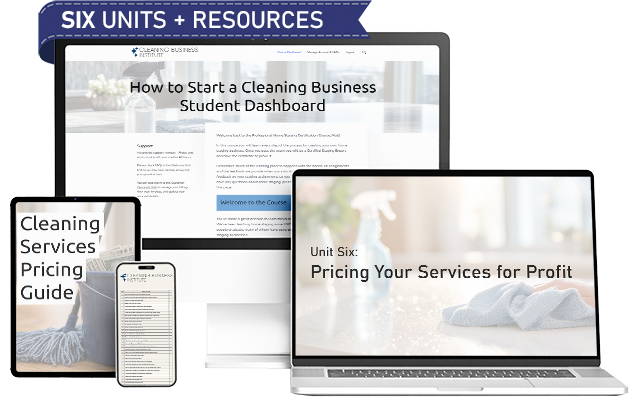
Cleaning Services Price List Template
When clients can see your prices laid out clearly, they trust you and decide faster. This guide shows how to build a cleaning services price list from your own costs, how to structure it so clients understand it, and how to publish starting prices without locking yourself into numbers that lose money.
See the coursesEverything on this page is yours to copy and adapt. The courses cover the decisions behind it: what to charge, what to promise, and what to put in writing.
What yours needs to cover
- ✓ Sections for recurring, one-off, deep-clean and move-out services
- ✓ Guidance on hourly, flat-rate and square-footage pricing
- ✓ A packages area to bundle services and raise your average job value
- ✓ An add-ons section for ovens, fridges, interior windows and similar extras
- ✓ Wording for "starting from" prices and what changes a quote
How to use it
- Work out your cost per billable hour before you write a single price.
- Group services into simple, easy-to-compare options.
- Create two or three packages so clients choose between options rather than decide yes or no.
- Publish starting prices, then confirm exact prices after a walkthrough or a timed first clean.
Start from your cost per hour, not from competitors
Most new cleaners copy a competitor's prices and discover months later that they were working for far less than they thought. The problem is billable time. A forty-hour week does not contain forty hours of cleaning. Driving, quoting, restocking and admin commonly take a large share of it, so the rate you charge per on-site hour has to carry all the hours you are not paid for.
Work it out once. Decide what you need to earn in a week, add your weekly costs (supplies, fuel, insurance, software), and divide by the hours you are realistically on site. That is your floor. Competitor prices tell you whether the market will pay it, not what it should be.
Choosing a pricing model for each service
Hourly pricing suits first-time deep cleans and jobs where you cannot predict the scope until you are inside, but it caps your income at your speed. Flat-rate pricing suits recurring maintenance cleans and rewards you for getting faster. Square footage is a quick way to reach a flat rate for a property you have not seen, especially in commercial work.
Most residential price lists end up mixing them. Recurring cleans are priced flat by home size, first cleans and deep cleans are quoted as a range or hourly with a minimum, and add-ons carry fixed prices.
Laying the list out so clients can choose
Structure the list the way a client decides. First, how often: weekly, biweekly, monthly, or one-off. Then, how big: priced by bedrooms and bathrooms, which clients know, rather than by square feet, which many do not. Then, extras. A short table beats paragraphs.
Show recurring prices lower than one-off prices, and explain why in one line. A recurring home stays cleaner between visits, so each clean takes less time. That turns the discount into a reason to commit rather than a sale.
Protecting yourself with "starting from" wording
Every published price should say what can change it: pets, clutter, condition, and access. Add a line saying the first clean is quoted after a walkthrough or priced as a deep clean, and that the recurring rate is fixed after it. This keeps your published numbers honest without committing you to clean a neglected home at a maintenance price.
A filled-in example
| Pricing basis | Built from a target cost per billable hour, reviewed every six months |
|---|---|
| Two-bedroom home | Weekly from a set rate, biweekly slightly higher, one-off higher again |
| Three-bedroom home | Same structure, priced from timed cleans of similar homes |
| First clean | Quoted after a walkthrough or charged as a deep clean, hourly with a minimum |
| Move-out clean | Quoted per property, includes inside cupboards, oven and fridge |
| Add-ons | Inside oven, inside fridge, interior windows, each a fixed price |
| What changes a quote | Pets, heavy clutter, property condition, parking and access |
Mistakes to avoid
- Pricing against a forty-hour week. If you divide your target income by forty, you undercharge by the share of your week spent driving and on admin. Divide by billable hours.
- Charging a regular rate for a neglected first clean. The first visit to a new home usually takes much longer. Price it separately and set the recurring rate afterward.
- Keeping hourly rates for regular clients. As you get faster at a home, hourly pricing lowers your income. Move recurring clients to a flat rate once you have timed the job.
- Never reviewing prices. Supplies, fuel and insurance change. Review the list at least once a year and give existing clients written notice of any rise.
Cleaning Services Price List Template FAQs
How much should I charge for cleaning?
It depends on your area, your costs and your profit goal. Work out what an hour of your time costs once you account for drive time and admin, then build prices from there and check them against local competitors.
Should I show prices publicly?
Publishing starting prices builds trust and filters out people looking for the cheapest possible option. Many cleaners publish "from" prices and confirm the exact figure after seeing the property.
Can you just tell me what to charge?
Nobody honestly can, because it depends on your costs, your area, and your margin. The free cleaning price calculator on this site gets you a starting number, and Unit 3 covers the formula behind it.
More cleaning business templates
Get every template, plus the training
Ten documents, one course that covers the thinking behind all of them, from the first quote to the contract you hand a commercial client.
Choose your course