Cleaning Business Pricing Models and When Each One Fits

Cleaning business pricing comes down to four models. Hourly pricing bills the time a job takes, a flat rate sets one price per visit, square-foot pricing scales with the size of the space, and per-room pricing adds up a set amount for each room. Most owners use two of them, chosen by the type of job rather than by habit.
The short version is that flat rates suit recurring homes, hourly suits jobs nobody can estimate, square footage suits commercial space, and per-room pricing suits quick quotes over the phone. All four rest on the same foundation, which is knowing what an hour of your work costs before you set any price at all.
The four cleaning pricing models side by side
Each model answers a different question. Hourly asks how long the job took. A flat rate asks what the job is worth. Square footage asks how much space there is, and per-room pricing asks what the space contains. The comparison below shows where each one fits and, more usefully, where each one goes wrong.
Hourly time
Where it breaksYou earn less every time you get faster at the same house.
Flat rate per visit
Where it breaksA quote given without a walkthrough can lock in a loss.
Square foot per area
Where it breaksFloor area says nothing about how many restrooms or kitchens it holds.
Per room per room
Where it breaksA bedroom with a walk-in closet and a box room cost the same.
The marked option is the one most residential owners settle on for repeat clients, and the reason is in the risk line. A flat rate moves the risk onto the cleaner, but it also hands the cleaner the reward for working efficiently. The next section shows that trade in numbers.
Why flat rates suit recurring house cleaning
A recurring client wants to know what next Tuesday will cost. A flat rate gives them that, and it gives the owner something better than an hourly bill, which is a price that stays the same while the time it takes shrinks. Every repeat visit to the same house tends to get quicker as the cleaner learns it.
Building the flat rate from your costs
Here is how that works for one illustrative job, a three-bedroom, two-bathroom home cleaned every two weeks. The assumptions are stated on each line, and the travel cost uses the IRS business rate of 76 cents a mile for the second half of 2026, from its published standard mileage rates.
The $33 between them is profit the business keeps after paying the owner a wage.
Notice that the owner's pay sits inside the cost line, not in the profit. That separation matters because a price that only covers wages leaves nothing for a slow month, a broken vacuum or the next insurance renewal. Profit is what the business earns on top of paying the person doing the work.
What happens when you get faster
By the fourth or fifth visit, the same house might take two and a half hours instead of three. On an hourly bill at $45 an hour, the invoice falls from $135 to $112.50, and the owner loses money for getting better at the job. On the flat rate, the price stays at $150 and the effective rate rises to $60 an hour.
That is the whole case for flat pricing on recurring work.
The catch is the quote itself. A flat rate given from photos, or from a client's own description of a "pretty clean" house, can lock in a loss for months. A walkthrough before the first visit is the protection, and our guide on how to charge for cleaning services covers setting the number for a single job.
When hourly pricing is the honest choice
Hourly pricing earns its place where neither side can predict the job. Charging a flat rate for an unknown amount of work means either padding the price heavily or gambling on it, and both damage trust. Billing the hours, with an estimate and a cap agreed up front, is fairer to everyone.
These are the jobs where hourly billing usually makes the most sense:
- A first deep clean of a home that has gone months without professional cleaning.
- Post-construction or post-renovation cleans, where dust settles into every surface.
- Heavily cluttered homes, where moving belongings takes as long as cleaning.
- Small one-off requests, such as two hours of help before a party.
- Extra time a regular client asks for on top of their usual visit.
In practice, many owners bill the first visit by the hour and then convert the client to a flat rate. The first visit shows how long the home really takes once it is under control, which turns the flat quote from a guess into a measurement.
Square-foot pricing for offices and commercial space
Commercial clients often ask for a price per square foot because it lets them compare bids and budget across several sites. The work behind it is still a time estimate. The owner walks the space, judges how many square feet an hour a cleaner can cover, and turns that into a rate.
As an illustration, take a 6,000-square-foot office cleaned five evenings a week. If a cleaner covers 2,000 square feet an hour in that layout, each visit takes three hours. At a commercial rate of $45 an hour, the visit costs $135, which works out to about 2.25 cents a square foot per visit and about $2,920 a month across 21.65 visits.
The weakness is that floor area hides the slow parts of a building. Restrooms, break rooms and glass partitions take far longer per square foot than open carpet. That is why experienced bidders price those areas separately or adjust the rate after the walkthrough, a process covered in more depth in our guide to getting cleaning contracts.
Per-room pricing and quick phone quotes
Per-room pricing is the fastest way to answer "how much would it be?" when a caller cannot wait for a walkthrough. The owner sets a base charge for the kitchen and living areas, then adds a fixed amount for each bedroom and each bathroom.
For example, with a base of $40, $25 per bedroom and $35 per bathroom, a three-bedroom, two-bathroom home comes to $185 for a first standard clean. The same menu prices a one-bedroom, one-bathroom apartment at $100, and the caller can do the arithmetic themselves, which builds confidence before anyone has visited.
The weakness shows up in unusual homes. A four-bedroom house with small rooms and a two-bedroom house with an enormous open kitchen can take the same time, yet the room count prices them far apart. So treat a per-room quote as a starting estimate and confirm it after seeing the home.
Mixing pricing models without confusing clients
Most established cleaning businesses do not pick one model. They build a short price menu where each part of the work uses the model that fits it, and they present it so the client sees one clear number per service.
A typical residential menu combines three parts:
- A flat rate for recurring visits, set after the first clean.
- A first-visit price, either hourly with a cap or the flat rate multiplied by a stated factor for the extra work.
- Fixed prices for add-ons such as inside the oven, inside the fridge or interior windows.
Writing that menu down also makes raising prices easier, because a flat rate changes as one number with notice. Here at the Cleaning Business Institute, close to two in three of the owners we work with have raised their prices at least once in the past year. Those who had a written menu found the conversation shorter.
If you want a starting layout, our cleaning services price list template sets out a menu in this shape, and the cleaning price calculator will run the cost lines above for your own numbers. To see what those prices add up to over a year, read how much a cleaning business makes.
Where the course goes further on pricing
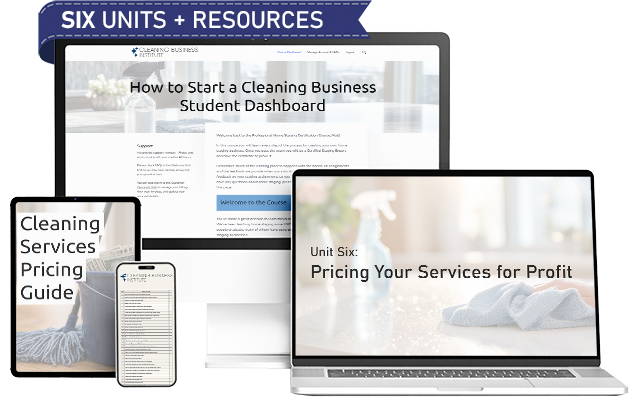
Unit 3 of the course, Pricing Your Services for Profit, works through the cost math in this post at full length. It covers the true cost of running the business, when to charge hourly, flat rate or by square footage, how to build packages for different clients, and how to handle a client who pushes back on price.
Unit 3 sits in both the Fundamentals Course and the Fast Track Course, so either tier carries it. Commercial bidding at scale, including recurring office contracts, comes later in Unit 10, Scaling and Long-Term Growth, which only the Fast Track Course includes. For a picture of the day-to-day work being priced, O*NET's profile of maids and housekeeping cleaners lists the tasks the role involves.
Ready to get started?
Our step-by-step courses take you from where you are now to a credential you can show, with templates, an online exam, and a 30-day money-back guarantee.
See the courses