How to Start a Cleaning Business With No Money Up Front
You can start a cleaning business with almost no money by cleaning homes with supplies you already own or can borrow, trading under your own name as a sole proprietor, finding clients through free channels, and paying for each upgrade out of the jobs it helps you win. The one cost not to defer is liability insurance for paid work in other people's homes.
That last point is what separates a lean start from a reckless one. Almost everything else in a cleaning business can be borrowed, postponed or skipped for the first few weeks, as long as the owner knows which item is which and buys them back in the right order.
What a no-money start really means
No money rarely means zero dollars. It means the owner earns before they spend, and spends only on what the next job needs. A few costs are hard to avoid entirely, and it helps to name them before the first booking so none of them arrives as a surprise:
- A local business license or registration, which some cities and counties charge a modest fee for.
- Liability insurance, which many insurers let a small business pay monthly rather than as a lump sum.
- Getting to jobs, whether that is fuel for your own car, transit fares or a lift from a partner.
- A phone that can take calls, texts and card payments.
Everything outside that list is negotiable. The startup cost calculator shows the gap between a full launch and a lean one, and our guide to what it costs to start a cleaning business explains each line for anyone who wants the fuller budget.
What to borrow, defer or skip at the start
Once the unavoidable costs are known, the rest of the usual startup list can be sorted by how long it can wait. The table below goes item by item, from the things you can skip outright to the one you should not.
| Item | Lowest-cash move | When to pay for it |
|---|---|---|
| Supplies | Use what you own and borrow the gaps | Replace each item as it runs out |
| Vacuum | Use your household machine | When it slows you down on every job |
| Business name filing | Trade under your own legal name | When you want a brand name on cards |
| LLC | Start as a sole proprietor | Once income is steady and worth protecting |
| Website and ads | A free Google Business Profile instead | After referrals stop filling the week |
| Software | A free calendar and a spreadsheet | When bookings outgrow them |
| Liability insurance | Do not skip it | Before the first paid clean for a stranger |
The pattern in the right-hand column is that each purchase waits for a reason, not a date. A new vacuum earns its place when the old one is costing time on every job, and an LLC earns its place when there are savings and income worth shielding.
Supplies you already have
That reasoning starts with the cleaning cupboard. Most households already hold an all-purpose spray, glass cleaner, a bathroom cleaner, sponges, a mop and a vacuum, which is enough for standard home cleans. Microfiber cloths are the one cheap purchase worth making early, because they clean faster than paper or old towels and wash for months.
If something is missing, ask before buying. Relatives and neighbors often have a spare bucket or an unopened bottle, and a borrowed steam mop is a perfectly good way to learn whether you need one. Our guide to cleaning business supplies lists the full kit for when the money arrives.
Paperwork that costs little or nothing
The paperwork can be just as lean. A sole proprietor trading under their own name usually needs only the local license or registration, and an Employer Identification Number from the IRS is free if a bank asks for one.
Requirements differ by state and city, so check your city hall and your state's business website. Our guide to registering a cleaning business walks through each filing.
How to fund the first weeks from the first jobs
Lean starts work because a cleaning business is paid quickly. A household client usually pays on the day of the clean, so the money from the first few jobs can pay for the next layer of the business before the owner has to dip into savings they do not have.
The order in which that money is spent matters more than the amounts. The figure below shows the sequence that keeps the owner protected while the business grows.
- 1
Liability insurance
Bought before cleaning for anyone outside friends and family.
Lets you accept work from strangers - 2
Local registration
The license or registration your city or county requires.
Makes the business legal to advertise - 3
Replacement supplies
Restock what the first jobs used, plus a set of microfiber cloths.
Keeps every clean to the same standard - 4
A tax reserve
Part of every payment moved to a separate account for tax.
Stops the first tax bill eating the business - 5
Tools and marketing
A better vacuum, cards or a paid listing, bought one at a time.
The tax step catches many lean starters out. Self-employed income carries self-employment tax as well as income tax, and nobody withholds it, so a reserve built from the first week onward is the cheapest protection the business will ever buy.
Clients who cost nothing to find
Funding from jobs only works if the jobs arrive, and the first ones should cost nothing to win. Tell everyone you know what you now offer, set up a free Google Business Profile, and post in neighborhood groups that allow it. Our guides to free ways to promote a cleaning business and finding the first clients cover each channel.
Where to borrow if you need to
Some owners need a little more than their cupboard holds, perhaps for a reliable vehicle or a commercial vacuum. Borrowing is possible, but new businesses find it harder than established ones. The Federal Reserve's Small Business Credit Survey found that firms under two years old with no employees yet were turned down for loans and credit lines more often than older ones.
Our own experience matches that. Here at the Cleaning Business Institute, about half of the students who told us they had applied for a startup loan in the last two years were turned down at least once. That is a reason to start small and borrow later, once there are bank statements showing income.
When borrowing does make sense, these are the usual routes, roughly from simplest to most formal:
- A loan from family or a friend, written down with an amount, a repayment schedule and both signatures.
- Equipment bought used, which avoids borrowing at all for many items.
- A microloan through a nonprofit lender. The SBA microloan program lends up to $50,000, and the SBA puts the average at about $13,000.
- A business credit card, used only for purchases the owner can repay within the month.
Free advice is easier to find than free money. A Small Business Development Center offers no-cost counseling on budgets and funding in most areas, and an hour there can stop an owner borrowing for something the business does not need yet.
Commercial cleaning on a shoestring
The lean route is harder on the commercial side, because businesses usually ask for an insurance certificate before anyone walks through the door. Two approaches still work with very little cash.
The first is to start with small accounts such as a single-room office, a shop or a dental practice, whose owners make the decision themselves and rarely need a formal bid.
The second is subcontracting for an established commercial company, which supplies the contract and the equipment while you supply the labor and learn how commercial work is run. Our guide to starting a commercial cleaning business explains the step up from there.
Either way, the bigger contracts come later. A lean start is slower than a funded one, and the honest trade is time for money. For a dated plan of the first month, see starting a cleaning business from scratch, and for the whole route, our pillar guide to how to start a cleaning business.
How the course fits
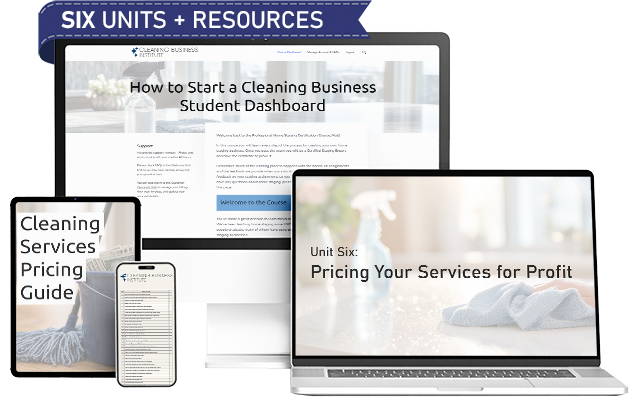
The Fundamentals Course covers the lean start in three of its six units. Cleaning Business Foundations builds a realistic launch budget, Setting Up Your Business covers registration and simple bookkeeping, and Getting Your First Clients sets out free listings, an introductory offer and outreach scripts.
The Fast Track Course adds Marketing on a Budget, which takes the free and low-cost channels further once the first clients are in. Both courses end with the same online exam for the C.C.B.P. credential.
Ready to get started?
Our step-by-step courses take you from where you are now to a credential you can show, with templates, an online exam, and a 30-day money-back guarantee.
See the courses