How to Get Clients for a Cleaning Business From Zero to 20
The first 20 clients for a cleaning business nearly always come from four places, in this order. They come from people who already know you, the people those first clients refer, your Google profile and neighborhood groups, and the streets around the homes you already clean. Paid ads rarely matter at this stage.
The work is mostly conversations. Plan your first six weeks around how many people you talk to about the business, not how much you earn, and the bookings follow from the conversations.
Why the first clients come from people who know you
A stranger hiring a cleaner is taking a risk. They are giving someone a key, or at least an afternoon alone in their home. With no reviews and no track record yet, the only thing that lowers that risk is a person they already trust saying you are reliable.
That is why the first bookings come through your own circle. Across the students we work with at the Cleaning Business Institute, close to nine in ten owners who launched in the past two years booked their first paying client through someone they already knew. The rest came from neighbors and local groups, not from ads.
Your circle is larger than it feels. Before you send a single message, write down everyone who could either hire you or pass your name on.
- Family, friends and neighbors, including the ones you only wave to.
- Former coworkers and managers, who know how you work.
- Parents from school, sports and childcare, who are often short of time.
- People you already pay, such as your hairdresser, mechanic or landlord.
- Members of any club, church or group you belong to.
Aim for 100 names, and keep adding as people come to mind. Each one gets a short personal message, not a group post, saying what you now do, the area you cover, and that you would be grateful for a client or a referral.
The message can be brief, as long as it sounds like you. Something like this works well.
"Hi Jennifer, I've started a home cleaning business covering Westside and Oak Park, mostly regular cleans every week or two. I'm insured and taking on my first clients now. If you, or anyone you know, could use a hand, I'd love to help. Would you be open to a quick quote?"
It names the area and the service, gives one reason to trust you, and ends with an easy question. It also asks for a referral without making that the point, which takes the pressure off a friend who does not need a cleaner themselves.
A six-week plan for the first 20 clients
The order below starts with the warmest people and moves outward. Each stage hands something useful to the next, which is why it works better in sequence than all at once.
- 1
Weeks 1 and 2, your own circle
Send a personal message to everyone on your list, and follow up once with anyone who replies.
Hands on your first few clients and your first reviews - 2
Week 3, Google and local groups
Publish your Google profile, introduce yourself in two neighborhood groups, and ask the first clients for reviews.
Hands on a listing strangers can check - 3
Week 4, the streets you already clean
Leave a card or door hanger on 50 to 100 homes around each current client.
Hands on clients who need no extra driving - 4
Week 5, two referral partners
Approach one realtor and one property manager with a specific offer for their clients.
Hands on a source that can send repeat work - 5
Week 6, the referral ask
Ask every client so far whether they know someone who needs a cleaner, with a reward for both sides.
Six weeks is a planning shape, not a promise. Some owners reach 20 in a month and others take a season, depending on the area and how many hours they can spend talking rather than cleaning.
The numbers behind 20 clients
It helps to know how much activity 20 clients needs, so a slow week does not feel like failure. The figures below are an illustration built on stated assumptions, not a forecast for your town.
Twenty conversations a week is about four a weekday, which fits around a part-time cleaning schedule.
The useful number is the first one. You control how many conversations you start, while you only influence how many book. Counting conversations keeps the plan moving in the weeks when bookings lag.
Make an introductory offer that attracts regular clients
A first-time offer gives a hesitant person a reason to try you now. The danger is attracting people who only ever want the discount, so the offer should reward the behavior you want, which is booking a recurring clean.
A sound structure ties the discount to the first visit of a regular plan. For example, a reduced price on the first clean for anyone who books every two weeks, with the normal price from the second visit. A one-off deep clean at half price, by contrast, tends to fill your week with jobs that never repeat.
Set the normal price first so you know what the discount really costs. The cleaning price calculator helps you find a rate that covers your time and supplies, and the price list template gives you something clear to send with every quote.
Turn the first clients into the next ones
The first 20 clients are also your first marketing team. Each one can leave a review, refer a friend and keep booking, and how well you serve them decides whether they do.
Three habits matter most at this stage. Ask every client for a review the same day, using a direct link. Ask for referrals once the client has had two or three good visits and knows your standard. Keep the schedule and the standard steady, because a client who stays a year is worth far more than any new one.
Two rules apply to friends and family. Google's policy on prohibited and restricted content treats reviews from relatives and close contacts as a conflict of interest, so do not ask them to review you. If friends post about the business on social media, the FTC's guides on endorsements and testimonials expect them to make their connection to you clear.
A referral reward for a friend who books is a different matter, and it is fine. A credit on the next clean for both the existing client and the new one is a common and fair way to say thank you. More free methods for keeping new names arriving are in how to promote a cleaning business.
Mistakes that slow down the first 20
The owners who take longest to reach 20 clients usually make the same few mistakes. Most are about where time goes.
- Spending on ads before asking people. Paid clicks to a profile with no reviews rarely book, while a message to a former coworker costs nothing.
- Accepting any job anywhere. Jobs 40 minutes apart eat the profit, so keep new clients near the ones you have.
- Answering slowly. An inquiry left until evening has often booked someone else. The guide to cleaning business leads covers fast replies.
- Apologizing for being new. Saying "I've only just started" undersells you. The guide to introducing your cleaning business has better openings.
Fix these and the six-week plan usually takes care of itself. The broader marketing plan, for after the first 20, is in how to market a cleaning business.
Where the course covers your first clients
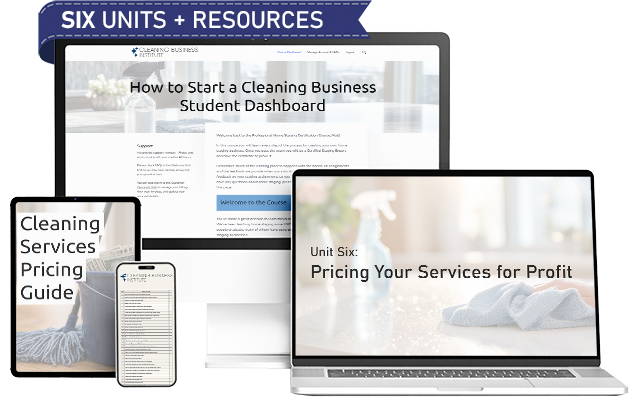
Unit 6 of the Cleaning Business Institute course, Getting Your First Clients, is built around this exact stage. It covers launching in a week and judging that week by conversations started, using your personal network, free listings, an introductory offer that gets a yes, and scripts for outreach.
Unit 6 is in the Fundamentals Course, along with Unit 5, Client Experience and Retention, which covers keeping those first clients and earning referrals from them. The Fast Track Course adds Unit 7, Marketing on a Budget, for the stage after the first 20.
Ready to get started?
Our step-by-step courses take you from where you are now to a credential you can show, with templates, an online exam, and a 30-day money-back guarantee.
See the courses