How to Market a Cleaning Business With a Simple Plan
To market a cleaning business, decide exactly who you clean for and where, build the few things that make a stranger trust you, then run two or three channels that reach those people every week. Track where each new client came from, and move your time and money toward whatever produces paying work.
That is the whole plan, and it fits on one page. Most cleaning businesses that struggle with marketing are not short of ideas. They are trying ten channels at once, with no record of which one booked the last client.
Start with who you clean for and where
Marketing a cleaning business begins with a narrow answer to one question. Who should call you? "Anyone with a dirty house" is not an answer, because no message, photo or ad can speak to everyone at once.
A useful answer names a type of client and a patch of map. "Busy two-income households in the three zip codes north of the river" tells you which neighborhood groups to join, which streets to leaflet, and which photos to take. "Small dental and medical offices within 20 minutes" points somewhere else entirely.
The service area matters as much as the client. Cleaning is sold locally and delivered by car, so every mile between jobs is unpaid time. A tight area makes the marketing cheaper and the schedule more profitable, which is why most owners draw it smaller than feels comfortable at first.
Once the who and the where are written down, the rest of the plan has something to aim at. Each channel can be judged by one test, which is whether it reaches those people in that area.
Build the trust assets before any channel
People let a cleaner into their home or office with nobody watching. So before a prospect books, they look for evidence that you are real, careful and consistent. Every channel you run later sends people to that evidence, and a weak version wastes the effort spent getting them there.
Four assets do most of that work. They are worth building in your first fortnight, before any money goes into reaching people.
- Google Business Profile
- The free listing that shows in local search and on Maps, with your services, area, photos and reviews in one place.
- Recent reviews
- A steady trickle of honest reviews from real clients, answered by you, so the newest ones are never months old.
- A simple website
- One to five pages naming your services, your area, how pricing works and how to book, readable on a phone.
- Your own photos
- Real before and after shots from your jobs, taken with permission, rather than stock images a prospect has seen elsewhere.
Google's own guidelines for representing your business are worth reading before you set the profile up. A service-area business run from home should hide its home address and set a service area instead, and the business name must be the real name, without extra keywords added to it.
Reviews deserve the most attention, because they go stale. Here at the Cleaning Business Institute, we've found that about three in four clients who booked through a Google listing in the last two years only paid attention to reviews from the past few months. An owner with forty reviews, none of them recent, can lose a booking to one with twelve from this season.
Choose channels by the stage of the business
With the assets in place, the question becomes where to spend your hours. The right channels change as the business grows, and copying what a ten-van company does in your first month is a reliable way to spend money without booking anyone.
The table below sets out a sensible order. It is a starting point to adjust, not a rule, and a commercial cleaner will lean harder on direct outreach at every stage.
| Stage | Lead with | Add when it is running |
|---|---|---|
| First month | People you know and your Google profile | Neighborhood groups and a flyer drop |
| First 20 clients | Referrals and review requests after every job | Partners such as realtors and property managers |
| Steady schedule | Referrals, reviews and a small paid search test | Seasonal offers to existing clients |
| Hiring a team | Paid search in a tight radius, tracked per client | Commercial outreach and contracts |
Each row has its own guide on this site. Free and neighborhood methods are covered in how to promote a cleaning business, and paid channels in cleaning business advertising. The launch stage has its own playbook in how to get your first 20 clients.
Notice what the order leaves out. Vehicle wraps, printed brochures, and a presence on every social network all come later, if at all. They are not useless, but they rarely book the first twenty clients, and they compete for the hours a new owner needs for cleaning.
Write the marketing plan on one page
A plan that runs to twenty pages does not get read twice. One page that you look at every Monday does more. The Small Business Administration's guidance on marketing and sales covers the general shape of a plan, and for a cleaning business it boils down to six lines.
- Who and where. The client type and the zip codes or radius you serve.
- The offer. What you sell first, such as a recurring biweekly clean, and how a new client starts.
- The message. One sentence on why a client should pick you, in words a client would use.
- The channels. Two or three, from the stage table, with the hours each gets per week.
- The budget. What you will spend to win a client, worked out from what a client is worth.
- The numbers. Inquiries, bookings and cost per client by channel, reviewed monthly.
The budget line is where most plans go vague. The way to fix it is to start from what one client is worth over a year, then decide how much of that you are willing to spend to win them.
Spending $150 to win a client worth $1,536 in a year is sound. Spending it on a one-off move-out clean worth $90 in profit is not.
Your own numbers will differ, so run them with the cleaning price calculator before you commit to a budget. The point of the exercise is the ceiling. Without one, any channel looks affordable until the month's bank statement arrives.
Run a weekly rhythm and track every client
A plan only works if it turns into small, regular habits. A few hours a week, done every week, beats a burst of activity followed by a month of silence, because reviews, referrals and search rankings all reward consistency.
Here is a rhythm that fits around a full cleaning schedule.
- Every day. Answer new inquiries within the hour where you can, and reply to any new review.
- After every job. Ask every client for a review, using a direct link or a QR code, as Google suggests in its tips to get more reviews.
- Every week. Post two or three real job photos, take part in one local group, and follow up any quote that has gone quiet.
- Every month. Count inquiries and bookings by source, work out cost per client, and drop whatever has not booked anyone in three months.
One rule about reviews belongs in the plan itself. Google prohibits offering a discount or free service in exchange for a review, so ask for honest feedback and never pay for it. A referral reward for a new client who books is a different thing, and is allowed.
The tracking line is what makes the plan improve. Ask every new inquiry how they heard about you and write it down. After three months, the answer to "where should I spend more" is sitting in a spreadsheet rather than in your memory. The guide to cleaning business leads covers how to turn those inquiries into bookings once they arrive.
How the course covers marketing
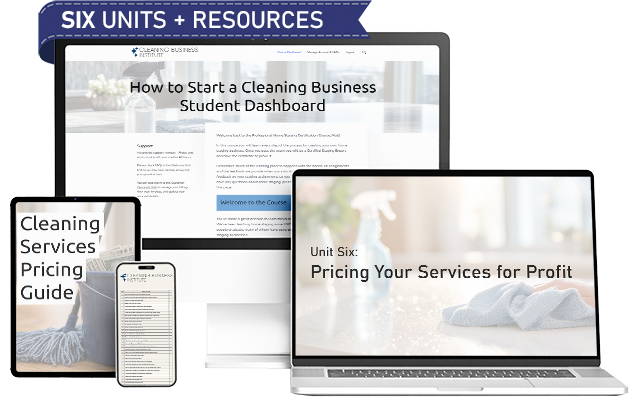
The plan above is the outline. The Cleaning Business Institute course fills it in. Unit 6, Getting Your First Clients, covers your network, free listings, an introductory offer and outreach scripts, and it is part of the Fundamentals Course.
Unit 7, Marketing on a Budget, goes further into Google listings, social media, flyers and door hangers, and partnerships with complementary businesses. It sits in the Fast Track Course alongside units on systems, hiring and commercial contracts. When you are ready to talk to prospects, the guide to introducing your cleaning business has scripts you can adapt.
Ready to get started?
Our step-by-step courses take you from where you are now to a credential you can show, with templates, an online exam, and a 30-day money-back guarantee.
See the courses