Cleaning Business Advertising, What Is Worth Paying For
Cleaning business advertising means paying to put your name in front of people who might hire you. For a local cleaner the paid channels that usually earn their keep are search ads, Google's Local Services Ads, lead marketplaces, paid social posts and targeted mail. Judge every one by what a booked client costs, never by the price of a click.
Advertising also works best second. A business with a thin Google profile and no recent reviews pays to send people somewhere that does not convince them, so get the free basics running first and treat advertising as the way to add volume once they work.
What counts as advertising for a cleaner
In this guide, advertising means paid placement only. You hand over money, and a platform or the mail carrier puts your message in front of people you choose. Everything you do for free, such as reviews, referrals, neighborhood groups and flyers you deliver yourself, is covered in how to promote a cleaning business.
The distinction matters because the two are judged differently. Free promotion costs hours, so the question is whether the time pays. Paid advertising costs cash on a meter, so the question is whether each dollar comes back as profit, and that can be measured to the cent. The wider plan that both fit into is set out in how to market a cleaning business.
The paid channels open to a cleaning business
Five channels cover nearly all the paid advertising a small cleaning company does. They differ mainly in how you pay and in how ready the person is to book when they see you.
| Channel | How you pay | Who sees it |
|---|---|---|
| Local Services Ads | Per lead, once a client contacts you | People searching for a cleaner right now |
| Search ads | Per click on the ad | People searching the words you bid on |
| Lead marketplaces | Per lead or quote, depending on the site | People asking several cleaners for quotes |
| Paid social | Per thousand views or per click | Local people who were not looking yet |
| Targeted mail | Per piece printed and delivered | Every household on the routes you pick |
The table hides one difference that matters a great deal. Someone typing "house cleaning near me" has already decided to hire. Someone scrolling a feed has not, so paid social and mail have to create the wish before they can capture it, and they convert more slowly.
Search ads and Local Services Ads
Search ads appear above the ordinary results when someone searches words you have chosen, and you pay when they click. They suit a cleaner because intent is high and you can draw the area tightly. Google's help on targeting ads to geographic locations explains how to restrict ads to a radius or a list of zip codes.
Local Services Ads sit above even the search ads and charge per lead rather than per click. House cleaning is an eligible category in the United States, and Google's getting started guide for Local Services Ads lists the checks a business has to pass, including a license or business registration and reviews, before its ads can run.
Lead marketplaces
Sites such as Thumbtack and Angi collect requests from people who want quotes and pass them to several businesses. The leads arrive quickly, which helps in a slow month. The catch is that you are often one of several cleaners contacted, so the lead goes to whoever answers first with a clear price.
Read each site's current terms before you sign up, because the way they charge changes and differs between categories. Then judge them exactly like any other channel, by the cost of a booked client.
Paid social and targeted mail
Paid posts on Facebook, Instagram or Nextdoor let you show before and after photos to people in chosen zip codes. They work best for a clear offer, such as a first deep clean for new recurring clients, aimed at an area where you already clean.
Targeted mail is the paper version. The USPS Every Door Direct Mail service delivers a card to every address on the carrier routes you select, without buying a mailing list. It suits an owner who wants to fill gaps around existing clients on one or two streets.
Work out what a client costs before you spend
Every paid channel reduces to one chain of numbers. A dollar buys some views, some views become clicks or calls, some of those become inquiries, and some inquiries book. Cost per booked client is the only number at the end of that chain that matters.
Benchmarks give a feel for the chain. LocaliQ's search ad benchmarks for home services report cleaning and maid services among the stronger categories for turning clicks into inquiries. Across the students we work with at the Cleaning Business Institute, paid search over the past year has turned roughly one click in six into an inquiry, though your own market will set its own rate.
Here is how the chain works out with round numbers. These are assumptions for the illustration, so replace each one with your own figures after a few weeks of data.
The inquiry looks cheap at $48. The client costs three times that, because two inquiries in three do not book.
Whether $144 is good depends entirely on what the client is worth. A recurring biweekly client can earn that back in a few visits, while a one-off clean may never cover it. The marketing guide works through what one recurring client is worth, and the cleaning business earnings calculator helps you set the ceiling.
The worked example also shows where to push. Raising the booking rate from one in three to one in two cuts the cost per client to $96 without spending a cent more on ads, which is why fast replies and clear quotes matter as much as the ad itself.
Run a first test that cannot run away
The safest way to start advertising is a small, capped test with a fixed end date. A test answers one question, whether this channel books clients at a cost you can afford, and it should not need a second mortgage to do it.
- Pick one channel. Search ads or Local Services Ads first for most home cleaners, because the intent is highest.
- Draw the area tightly. Target only the zip codes you want to drive to every week.
- Cap the budget. Set a daily limit you could lose entirely without harming the business.
- Exclude wasted searches. Add words like "jobs" and "hiring" as negative keywords so job seekers do not cost you clicks.
- Track every inquiry. Use a dedicated number or form, and record which inquiries book.
- Decide after six weeks. Keep, adjust or stop, based on cost per booked client against your ceiling.
Most failed tests fail at step five. Without tracking, an owner sees the ad spend on the card statement but cannot say which clients it brought in, and the decision becomes a guess.
What makes a cleaning ad worth clicking
Once the targeting is right, the ad itself still has to earn the click. Cleaning ads that work tend to share a few traits, whatever the platform.
- The headline names the service and the place, such as "Biweekly house cleaning in Northside".
- The image is a real photo from your own job, not stock.
- The offer is specific and honest, with any conditions stated plainly.
- Trust details appear early, such as insured, reviewed and locally owned, and every one of them is true.
- The next step is single and clear, such as "Get a quote in two minutes".
The landing page has to keep the promise the ad made. An ad for biweekly cleaning in one neighborhood should land on a page about exactly that, with a price range and a booking form, rather than on a homepage the visitor has to search.
Where the course covers advertising
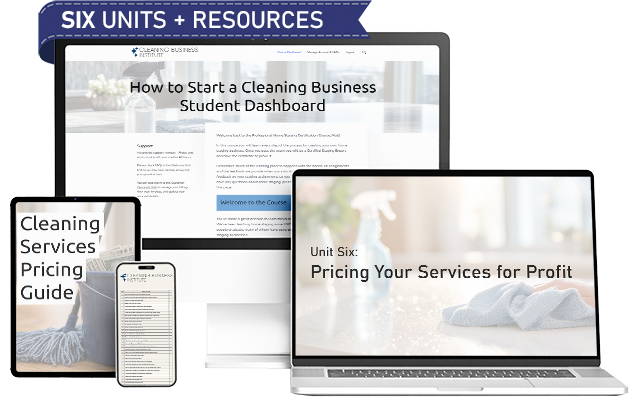
The Cleaning Business Institute course treats advertising as something you add once the free basics work, and it teaches it in that order. Unit 3, Pricing Your Services for Profit, gives you the cost numbers that tell you what a client is worth, and Unit 6, Getting Your First Clients, covers listings and the introductory offer. Both are in the Fundamentals Course.
Unit 7, Marketing on a Budget, covers Google listings and local search, social media, and the flyers and door hangers that pair with targeted mail. It is part of the Fast Track Course. If paid ads are bringing inquiries that do not book, the guide to converting cleaning business leads is the next place to look.
Ready to get started?
Our step-by-step courses take you from where you are now to a credential you can show, with templates, an online exam, and a 30-day money-back guarantee.
See the courses