How Much Does It Cost to Start a Cleaning Business
A home-based residential cleaning business can be started for about $1,300 to $1,900 on the assumptions worked through below. That covers registration, a first year of liability insurance, a starter kit of supplies and some basic marketing, with a website, software and vehicle signage as optional extras. A commercial launch costs more, mainly because of equipment.
Those totals are built from stated line items rather than a survey, so every figure can be changed to fit your town and your plans. The cleaning business startup cost calculator does the same sum with tick boxes, and this post explains what sits behind each line.
A worked startup budget for a residential cleaner
The budget below assumes one owner cleaning homes, working from home, using a car they already own, and buying only what the first few jobs need. Each amount is an assumption, not a quote, and the notes say where it comes from.
The three extras add $600, and none of them is needed to clean a first home.
The insurance line is the largest, and the $580 comes from the averages in Insureon's cleaning business insurance cost guide. That matches what we see in practice.
Here at the Cleaning Business Institute, we've found that the first year of liability cover has been the single biggest line in the typical launch budget our students bring us over the past two years, at a little under $600. That is worth knowing before you shop, because a cheaper policy is not always a narrower one.
What each line covers and where to save
Each line in the ledger can move up or down, and some can be pushed back until the first payments arrive. The useful question for every line is whether a first client would notice it was missing.
- Registration. A sole proprietorship with a name filing is the cheapest start. An LLC adds a state filing fee that varies widely, and our guide to forming an LLC for a cleaning business covers when it is worth it.
- Insurance. Do not skip it. A client who asks whether you are insured wants a certificate, and one broken item can cost more than the premium.
- Supplies. Buy for the services you sell, not for every service you might sell. Our cleaning business supplies guide lists the kit by service type.
- Marketing. A free Google Business Profile and asking people you know cost nothing. Printed cards and flyers are the cheapest paid step.
The three optional lines are easy to defer. A phone calendar works as scheduling software for the first handful of clients, and a website matters more once people are searching for you by name. For a launch with almost no cash, see how to start a cleaning business with no money.
How the budget changes for commercial and specialty work
The residential budget is the low end because homes need only portable kit. Offices, carpets and windows each bring equipment that a house cleaner never buys, and clients in those markets often ask for higher insurance limits. The scenarios below show what changes, each as an assumption.
| Business | What gets added | Assumed extra |
|---|---|---|
| Residential, home-based | Nothing beyond the core kit | $0 |
| Small offices, after hours | Backpack vacuum, larger mop system, more chemicals | $800 |
| Commercial floors | Floor machine and pads, wet-floor signs | $2,500 |
These extras are illustrations, so price the specific machines you need from local suppliers before committing. Many owners rent a floor machine for the first few jobs and buy only once the contract is signed. Our guide to starting a commercial cleaning business covers that market in more depth.
Costs that arrive after launch day
A startup budget ends on launch day, but the bills do not. Several costs arrive in the first months and are easy to leave out of the plan, because none of them shows up on a shopping list:
- Driving. Fuel and wear add up fast between jobs. The IRS standard mileage rate for business use, 76 cents a mile at the time of writing, is a fair way to cost it.
- Self-employment tax. A sole proprietor pays it on top of income tax. The IRS self-employment tax page sets the rate at 15.3% of net earnings, subject to the limits explained there.
- Restocking. Chemicals, cloths and vacuum bags run out on a schedule that tracks the number of jobs.
- Renewals. Licences and insurance renew every year, usually at a slightly different price.
Driving is the one that surprises people most. At 76 cents a mile, a week with 60 miles between jobs costs $45.60, or about $182 a month over four weeks. That money comes out of every job, so it belongs in your prices from the start.
Keep a small cash cushion
The last startup cost is not something you buy. It is cash held back to cover the gap between doing the first jobs and getting paid for them, plus the first month of restocking and fuel.
A cushion of a few hundred dollars covers most early surprises for a solo residential cleaner. Using the driving figure above, $182 for a month of mileage plus a $100 restock comes to $282. Rounding that up gives a sensible cushion to hold back on top of the launch budget.
The Small Business Administration's planning guide treats working cash the same way, as part of what it takes to start rather than an afterthought. If you are still deciding what to put in the plan, our checklist of what you need to start a cleaning business lists the legal, money and kit items together.
How quickly a cleaning business earns back its startup cost
A startup budget only means something next to what the business brings in. The quickest way to judge it is to count how many paid cleans it takes to cover the launch, using a price and a cost per job you can defend.
Here is one illustration. Suppose a standard clean of a three-bedroom home is priced at $150, and each job uses about $8 of supplies and 12 miles of driving. At 76 cents a mile the driving costs $9.12, so each clean leaves roughly $133 after its direct costs.
On that assumption, the $1,280 core budget is covered by the tenth clean, since nine cleans leave about $1,196 and ten about $1,329. Even the $1,880 budget with every extra is covered by the fifteenth. A cleaner booking five homes a week would reach either point within a month or so.
The illustration leaves out the owner's own pay and taxes, which is why it is a payback count and not a profit figure. Your own price will depend on your market, and the cleaning price calculator gives a starting range for a job.
What the sum shows is that a lean launch is recovered in weeks. An equipment-heavy launch is different, because a floor machine and its pads, assumed at $2,500 above, need a signed contract behind it before the purchase makes sense. That is the strongest argument for starting small and letting the first clients pay for the next piece of kit.
How the course turns this into a launch budget
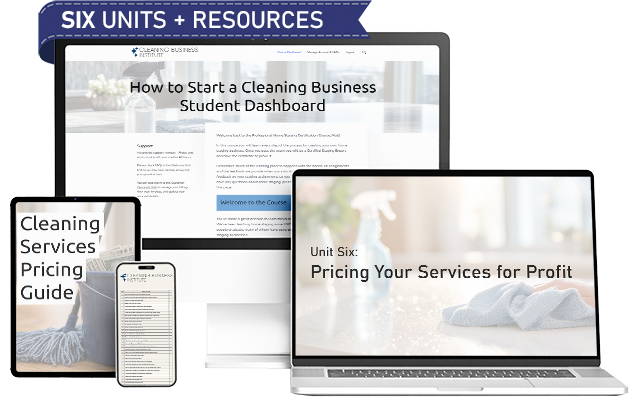
The Fundamentals Course starts with money. Unit 1, Cleaning Business Foundations, covers evaluating startup costs and building a realistic launch budget, alongside the legal basics of structures, licences and insurance. Unit 2, Setting Up Your Business, then covers registration, the business bank account and simple bookkeeping.
Unit 3, Pricing Your Services for Profit, closes the loop by showing how costs like mileage, restocking and insurance belong inside each job price. Equipment for growth, such as a second kit for a hired cleaner, comes up again in Unit 9, Hiring and Growing Your Team, in the Fast Track Course.
Ready to get started?
Our step-by-step courses take you from where you are now to a credential you can show, with templates, an online exam, and a 30-day money-back guarantee.
See the courses