What Do You Need to Start a Cleaning Business? The Checklist
To start a cleaning business you need four groups of things. The legal items are a local business license or registration, a tax ID and liability insurance.
The money items are a business bank account, a price list and a way to take payment. The kit is supplies, equipment and transport, and the systems are a cleaning checklist, a client agreement, a calendar and an invoice.
Not all of that is needed on day one. Some items must be in place before the first paid job, and others can wait until the business is earning. The checklist below sorts them, so a new owner spends early money only on what the first clients will actually notice or need.
The table that follows is the whole checklist on one screen, with each category split into what is due now and what can come later.
| Category | Before the first paid job | Can wait |
|---|---|---|
| Legal | Local registration, EIN, liability insurance | LLC, bond, workers' comp until you hire |
| Money | Bank account, price list, card payments | Accounting software, a bookkeeper |
| Kit | Core supplies, vacuum, transport | Commercial machines, vehicle signage |
| Systems | Checklist, agreement, calendar, invoice | Scheduling software, a website |
Each row is explained below. Where a topic needs more than a checklist line, the section links to the guide that covers it in full.
The legal items
The legal side is shorter than most people expect. In most states there is no license specifically for cleaning, so the requirements are the ones nearly every small business meets:
- A business structure. Sole proprietor to start, or a limited liability company (LLC) if you want business debts kept apart from personal assets. Our guide to an LLC for a cleaning business compares the two.
- A name filing. A DBA ("doing business as") if you trade under a name other than your own.
- A local license or registration. Issued by the city or county, and the item that varies most from place to place.
- An Employer Identification Number. Free from the IRS, needed to hire, and usually asked for by banks.
- Sales-tax registration where it applies. Some states tax certain cleaning services, so check with your state's revenue department.
Because the rules differ by state and city, check your state's own business website and your city hall rather than a national list. The SBA's licenses and permits guide explains how the layers fit, and our guide to which licenses a cleaning business needs goes into detail.
Insurance and bonding
Insurance sits with the legal items because it is the one most clients ask about. Liability insurance is the most common cover small businesses carry, held by 91% of the firms in the Federal Reserve's Small Business Credit Survey.
Cleaning owners are no exception. Across the students we work with at the Cleaning Business Institute, nine in ten of those who took on a commercial client in the last two years had general liability cover in place before the first walk-through.
The four covers below are the ones a cleaning business meets most often. Only the first is needed on day one.
- General liability
- Pays if you damage a client's property or someone is hurt because of your work. Buy it before the first paid job.
- Janitorial bond
- Repays a client if an employee steals. Usually a client expectation rather than a legal requirement.
- Workers' compensation
- Covers employees hurt at work. Required in most states once you hire, with rules set by each state.
- Commercial auto
- Covers a vehicle used for business. Check whether your personal policy covers driving between jobs.
Our guides to cleaning business insurance and getting bonded explain what drives the cost of each.
The money items
With the legal side settled, the business needs a way to price, collect and track money. Keeping business money separate from personal money from the first day makes every later task easier, from tax returns to loan applications.
- A business bank account, used for every business payment in and out.
- A price list worked out from labor, supplies, overhead and profit. The cleaning price calculator does the arithmetic, and the price list template gives it a clean format.
- A way to take card payments on the day, as well as bank transfer.
- A simple bookkeeping record, even a spreadsheet, with every payment and expense on it.
- A tax reserve in a separate account, because nobody withholds tax from self-employed income.
The tax reserve deserves a note. The IRS expects sole proprietors to make estimated tax payments during the year if they expect to owe $1,000 or more, so a reserve built from the first payment onward stops a surprise bill later.
The kit
Kit is where new owners most often overspend, buying for every possible job instead of the jobs they have booked. For standard home cleaning, a starter kit covers the following:
- Microfiber cloths in several colors, one color per area.
- An all-purpose cleaner, glass cleaner, bathroom cleaner and a registered disinfectant.
- A vacuum with attachments, a flat mop and bucket, and scrub brushes.
- Gloves, trash bags, an extension duster and a caddy.
Transport completes the kit. Most solo owners use their own car, so check that it holds the supplies comfortably and that your insurer knows it is used for work. Our guide to cleaning business supplies breaks the kit down by service type, and the startup cost calculator adds up your own list.
The systems
Systems are the part of the checklist that clients never see listed but always notice. They are what make the second visit as good as the first, and they are what will let someone else clean to your standard later on.
Four of them are needed before the first job. A room-by-room cleaning checklist sets the scope and keeps quality steady. A written service agreement sets the price, the schedule and the cancellation terms. A calendar with reminders stops double bookings, and a numbered invoice records every job. The cleaning business templates include all four ready to edit.
Keys, alarm codes and client records
One more system matters the moment a client hands over a key. Record which clients have given keys or alarm codes, store keys tagged with a code rather than a name or address, and keep codes out of shared message threads.
The reason is simple. A lost key labeled with an address is a security problem for the client and a reputation problem for the business.
A simple client record holds the rest, including contact details, access notes, pets, products to avoid, and the date and scope of every visit. Kept in one place from the first client, it becomes the history that lets anyone cover a visit if the owner is ill.
Software can wait until the calendar is busy enough to need it. When it is, our guide to the best CRM for a small cleaning business explains what to look for.
What can wait until the business is earning
Everything on the right of the opening table can be bought later from the business's own income. That includes the items below, each of which earns its place once the business is steady:
- An LLC, once there is income and savings worth shielding.
- A website, once referrals and free listings stop filling the week.
- Vehicle signage and printed workwear, once you are in the same streets often.
- Commercial machines, once a booked job needs them.
For the order of the whole process, see the pillar guide to how to start a cleaning business. For a printable version of this list, the cleaning business startup checklist has every item with a box to tick.
How the course fits
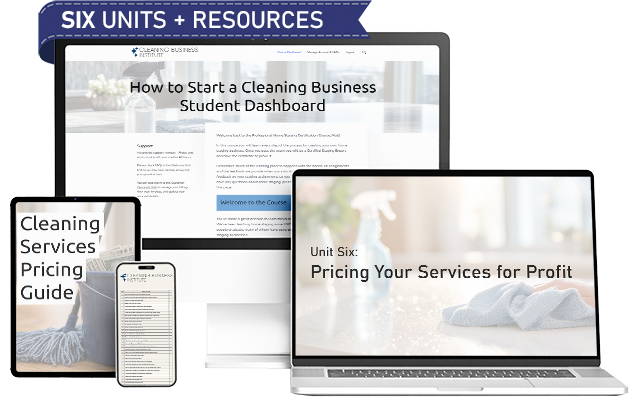
The Fundamentals Course works through this checklist in its first two units. Cleaning Business Foundations covers the legal basics, business structures, licenses, insurance and the launch budget. Setting Up Your Business covers registration, banking, bookkeeping and the policies for cancellations, payments and scheduling.
Cleaning Techniques and Standards then covers the kit and the methods, and Pricing Your Services for Profit builds the price list. The Fast Track Course adds Systems for Efficiency, which turns the checklist, calendar and invoicing into routines that run without the owner.
Ready to get started?
Our step-by-step courses take you from where you are now to a credential you can show, with templates, an online exam, and a 30-day money-back guarantee.
See the courses