How to Start a Commercial Cleaning Business and Win Contracts
To start a commercial cleaning business, begin with small workplaces you can clean yourself in the evening, such as dental practices, real estate offices and small clinics. Register the business, carry liability insurance before you bid, quote only after walking the building, and put the scope in a written contract. Hire your first part-time evening cleaner once two or three accounts are steady.
That order matters more than any single step. A commercial cleaning business is paid by the month, judged by the month, and lost when standards slip. The owners who last start with accounts small enough to clean well and price properly, then grow into bigger buildings once the systems and staff exist.
What commercial cleaning covers and where to start
Commercial cleaning means cleaning places of business rather than homes. The trade often calls it janitorial work. It is a large field. O*NET, the Department of Labor's occupation database, counts about 2.4 million people employed as janitors and cleaners, against about 1.4 million maids and housekeeping cleaners.
Within that field, the clients differ a great deal in what they need from a new company. Some can be served by one person with a vacuum and a mop cart. Others need crews, floor machines and training records before they will even read a bid.
- Small offices
- Practices, agencies and professional firms with a few thousand square feet. One person can clean them in an evening, and the owner often decides alone.
- Mid-size offices
- Several floors or tenants, often managed by a property manager. They expect a crew, a supervisor and a written inspection routine.
- Retail and warehouses
- Large hard floors that need machines, plus tight windows before opening. Equipment cost rises sharply here.
- Specialty sites
- Medical, school and food settings with their own hygiene rules and training requirements. Better left until you have a record.
Most new owners should aim at the first group. Those accounts are small enough to win without a track record and simple enough to clean to a high standard. They also teach the commercial habits (written scope, after-hours access, monthly invoicing) that the larger accounts will expect.
If offices are the whole plan, our guide to running an office cleaning business goes further into night schedules, keys and contract clauses.
What you need before the first commercial bid
Commercial buyers check paperwork before they check prices. A facility manager who hands keys to an outside company wants proof that the company exists, is insured, and can be held to a contract. So the setup work comes first, and it is mostly administrative.
Before you walk into a prospect's building, have these in place.
- A registered business. Most owners need a local business license or registration, and some states also require sales-tax registration for cleaning services. The SBA's licenses and permits guide explains where to check. There is generally no state license specifically for cleaning.
- General liability insurance. Commercial clients routinely ask for a certificate of insurance with the bid, and some ask to be named on it. Our post on cleaning business insurance covers the policies and what drives the cost.
- A janitorial bond, if your buyers expect one. A bond is not a legal requirement in most places, but many offices ask for it because your staff will be alone with their property. See how to get bonded.
- Commercial-grade basics. A backpack or commercial upright vacuum, a microfiber mop system, a cart, wet-floor signs and concentrated chemicals with their safety data sheets on hand.
Equipment is where new owners overspend. Floor scrubbers and carpet extractors can wait until a contract needs them, and many owners rent them for periodic jobs at first. The startup cost calculator lets you price your own list rather than borrowing someone else's total.
How to win your first commercial contract
With the paperwork ready, the first contract usually comes from direct outreach rather than advertising. Small business owners rarely search for a cleaner until the current one lets them down. Being known to them before that happens is most of the work.
The route from a list of prospects to a signed account follows a fairly fixed order, because each stage produces what the next one needs.
- 1
Build a short list
Pick thirty to fifty small workplaces within a short drive, and find out who decides on cleaning at each.
Hands on names to contact - 2
Ask for a walkthrough
Visit in person, ask what bothers them about the current cleaning, and ask to see the space.
Hands on a measured site and their complaints - 3
Write the scope
List every area, task and frequency, plus what is excluded, before any price appears.
Hands on the hours the job will take - 4
Submit a proposal
Send the scope, the monthly price, the schedule and your insurance certificate together.
Hands on a decision, or a question - 5
Follow up and start
Check back within a few days, then weekly. Once signed, clean the first weeks yourself.
The third step decides whether the account will make money. A written scope turns a vague request into hours, and hours are what you price. The cleaning proposal template shows how to lay one out, and our post on getting cleaning contracts covers bids and tenders in more depth.
Many owners who reach this point already run a residential round. Across the students we work with at the Cleaning Business Institute, close to two in three who started in homes have asked about adding a commercial account within their first two years, usually because a house client mentioned the office they manage.
Pricing a commercial account so it pays
Commercial work is quoted as a monthly figure, but it is built from hours. The safest method is to estimate the time each visit takes, cost that time honestly, add supplies and overhead, and then add a margin. Square-foot rates are a useful check, not a starting point.
Here is how that works for one illustrative account. The assumptions are stated so you can swap in your own.
Dividing the cost by 0.75 gives about $1,063, rounded to $1,065. A 25% margin on the price is not the same as adding 25% to the cost.
The labor rate in that example sits a little above the O*NET median wage for janitors of about $17.71 an hour, with an allowance for payroll taxes and workers' compensation. Your local wage and your own payroll costs will move it. Put your own wage and payroll costs into the same lines before you quote.
Two pricing mistakes recur. The first is guessing hours from photos instead of walking the site. The second is quoting to beat the current cleaner, which wins accounts that cannot be cleaned well at that price. Our guide to cleaning business pricing compares hourly, flat and square-foot models in detail.
Staffing night work and keeping standards
Once two or three accounts are steady, the owner's evenings fill up. That is the signal to hire. Commercial cleaning suits part-time staff, because most of the work happens after 6 p.m., and many good candidates want a few evening hours alongside a day job or study.
Hiring changes what the owner does rather than reducing the work. In practice the jobs that replace cleaning are these.
- Training each new cleaner on site, from a written checklist for that building.
- Inspecting accounts on a schedule the cleaners cannot predict.
- Handling the client relationship, including complaints, before they become cancellations.
- Keeping key and alarm-code records, and recovering keys when someone leaves.
Commercial clients rarely complain twice. Most simply put the contract out to bid. That is why inspections matter more here than in house cleaning, and why the first few weeks of any account are best cleaned by the owner. Our guide to hiring cleaners covers vetting, pay and the employee or contractor question.
When larger contracts make sense
Bigger buildings and public-sector work become realistic once you have references, a supervisor and the equipment record to show for it. Government cleaning contracts are open to small firms, and the SBA's federal contracting pages explain registration and set-asides. They are competitive and paperwork-heavy, so treat them as a later step rather than a first target.
Certifications commercial clients ask about
Some commercial buyers, especially in healthcare, schools and larger offices, ask about recognised industry credentials before they award a contract. They are rarely required for a small office account, but knowing which ones exist helps you answer the question when it comes. Janitorial certifications compared sets out what each one covers and who asks for it.
How the course fits
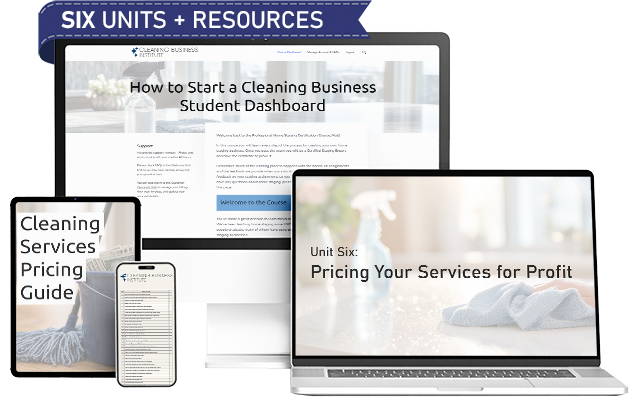
The Fast Track Course covers the commercial route from first decision to recurring contracts. Unit 1, Cleaning Business Foundations, deals with choosing between residential, commercial and specialty work. Unit 3, Pricing Your Services for Profit, works through hourly, flat-rate and square-foot pricing with real cost math.
The commercial growth material sits in the Fast Track units. Unit 9, Hiring and Growing Your Team, covers finding and training reliable cleaners, and Unit 10, Scaling and Long-Term Growth, covers adding commercial contracts for recurring revenue. The Fundamentals Course carries the first six units for anyone starting smaller.
Ready to get started?
Our step-by-step courses take you from where you are now to a credential you can show, with templates, an online exam, and a 30-day money-back guarantee.
See the courses