Janitorial Certifications Compared, and Which Ones Clients Ask For
No janitorial certification is required to run a cleaning company in the United States, but a few are recognized and some clients ask for them. The main ones are ISSA's CIMS for whole cleaning organizations, GBAC STAR for a facility's infection-control program, Green Seal GS-42 for green cleaning services, and IICRC certifications for technicians such as carpet cleaners.
Most clients ask for something more basic first. A certificate of insurance, a janitorial bond and proof that staff are trained come up in almost every commercial bid. The certifications matter when the client is large, medical or committed to green building, and each fits a different kind of work.
What a janitorial certification is, and what it is not
The words get mixed up, so it helps to separate them before comparing anything. Each one answers a different question a client might have about a cleaning company.
- A license is permission from a government to trade. For cleaning it is usually a general local business license rather than anything specific to the work.
- A certification is a private body's statement that a person or a company meets its standard, after training, an exam or an assessment.
- An accreditation usually applies to a place or a program, such as a building whose cleaning procedures have been reviewed against a standard.
- Insurance and bonding are financial protection for the client, and they are what most clients check first.
That last point shapes how a new owner should spend their effort. A small office manager wants to know who is liable if something breaks or goes missing. Our guide to getting bonded covers that side, and it comes before any certificate.
The main janitorial certifications compared
With the basics in place, the certifications fall into a few clear groups. The table below sets out the main ones side by side, including what each actually certifies, since several apply to a building or a company rather than to a person.
| Credential | What it certifies | Who tends to ask for it |
|---|---|---|
| ISSA CIMS | A cleaning company's whole management system | Large property managers and formal bids |
| CIMS Green Building | CIMS plus green cleaning practices | Buildings with green building goals |
| GBAC STAR | A facility's cleaning and infection-control program | Facilities showing outbreak readiness |
| Green Seal GS-42 | A cleaning service's green cleaning operation | Clients with sustainable purchasing rules |
| IICRC CCT | One technician's carpet cleaning knowledge | Carpet clients and property managers |
| OSHA training | Not a certification, an employer's training duty | Medical offices and larger accounts |
| C.C.B.P. | An owner's training in running the business | Rarely a client, since it serves the owner |
The pattern to take from it is that the best-known janitorial credentials certify organizations and buildings. A one-person company can work toward some of them, but most are designed for businesses with staff, written procedures and a record to assess.
ISSA CIMS, the organization-wide standard
The Cleaning Industry Management Standard, or CIMS, comes from ISSA, the cleaning industry association. It assesses a whole company across five areas of management, which are quality systems, service delivery, human resources, health and safety with environmental stewardship, and management commitment.
An independent assessor checks the company against the standard. ISSA's FAQ says a company must meet every mandatory element and at least 60% of the recommended ones in each section, then recertify every two years. It applies to companies of any size, though a very small one may struggle to show the written systems it expects.
GBAC STAR, for infection control
The Global Biorisk Advisory Council, a division of ISSA, runs GBAC STAR facility accreditation. It accredits a facility's cleaning and disinfection program against a 20-element framework, so the building holds it rather than the contractor. A cleaning company serving an accredited building will be asked to clean to that program, and GBAC offers online training for individual workers.
Green Seal GS-42, for green cleaning services
Green Seal's GS-42 standard certifies cleaning services for commercial and institutional buildings. It covers building-specific cleaning plans, sustainable purchasing, staff training and communication with tenants. It suits a company whose clients have written sustainability goals, and it means little to a client without them.
IICRC, for technical specialties
The IICRC certifies individual technicians rather than companies. Its Carpet Cleaning Technician certification covers fiber identification, cleaning chemistry and methods, and it has no prerequisites. Other IICRC certifications cover specialties such as water damage restoration. These matter when the work itself is technical, not for routine office cleaning.
Which certifications clients actually ask for
What a client asks for depends mostly on who they are. The requests below are the usual pattern by client type, from the smallest accounts to the most demanding:
- Small offices and shops ask for a certificate of insurance, often a bond, and sometimes background checks. Certifications rarely come up.
- Property managers want to be named on the insurance certificate and often ask for a written safety program. Larger firms may score CIMS in a formal bid.
- Medical and dental offices ask about infection control and bloodborne pathogens training, and some prefer contractors familiar with GBAC procedures.
- Buildings with green goals may require Green Seal GS-42 or CIMS Green Building, usually written into the bid documents.
- Government and institutional buyers list any required credentials in the solicitation, so read it before assuming one is needed.
The medical end of that list is closer to everyday cleaning than many owners expect. Here at the Cleaning Business Institute, about two in five of the janitorial owners we have worked with over the past two years say infection control comes up in their work every day. Restrooms, break rooms and clinics all bring it in.
The safety training behind those requests
Much of what clients call certification is really proof of safety training. OSHA does not certify cleaners, but employers must train staff on the hazardous chemicals they use under its hazard communication standard. Workers with occupational exposure to blood, which can include some medical and restroom cleaning, need bloodborne pathogens training.
A training log with dates, topics and signatures answers most of these questions. It costs little to keep, and it is often what a property manager actually wants when a bid form asks about certification.
Which janitorial certification to add first
Because each credential fits a different kind of work, the right first one depends on what the business does next. Adding one nobody asks for costs time and money and wins nothing. A short rule of thumb, tied to the work rather than to prestige, looks like this:
- Offering carpet or upholstery cleaning points to the IICRC technician certification for whoever does the work.
- Cleaning medical offices or clinics points to documented bloodborne pathogens training first, then GBAC online training if clients mention it.
- Bidding on large buildings points to CIMS, once the company has staff, written procedures and a record an assessor can review.
- Serving clients with green purchasing rules points to Green Seal GS-42 or CIMS Green Building, whichever the bid documents name.
For a small company cleaning offices and shops, none of these may be needed yet. Insurance, a bond, a training log and good references win most of that work.
Where the Cleaning Business Institute certificate fits
The Cleaning Business Institute awards the Certified Cleaning Business Professional (C.C.B.P.) credential, so it is worth being plain about what it is. It is a training certificate in running a cleaning business, earned by passing an exam.
It is not a technical cleaning certification, and it does not assess an organization the way CIMS does. Nor does it meet a bid requirement for any of the credentials above.
What it does show is that the owner has studied pricing, contracts, client retention and hiring. Our certification standards page explains what the exam covers and how the credential sits alongside licenses and third-party certifications. Many owners hold both kinds.
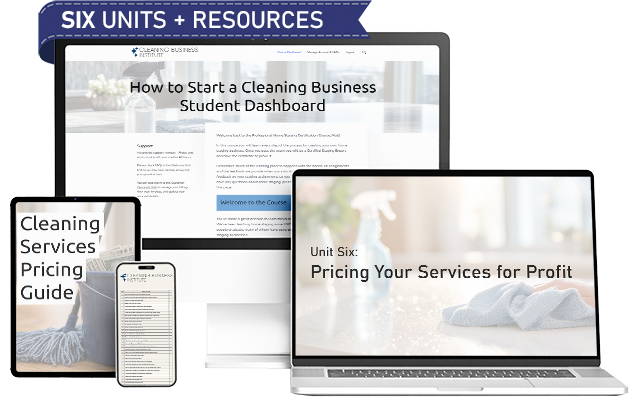
The courses come in two tiers. The Fundamentals Course covers Unit 1, Cleaning Business Foundations, which includes licenses and insurance, and Unit 4, Cleaning Techniques and Standards, on consistent quality. The Fast Track Course adds Unit 9, Hiring and Growing Your Team, and Unit 10, Scaling and Long-Term Growth, which covers adding commercial contracts.
For the commercial side in more depth, our guide to starting a commercial cleaning business covers the insurance, bonding and paperwork buyers check before the first bid.
Ready to get started?
Our step-by-step courses take you from where you are now to a credential you can show, with templates, an online exam, and a 30-day money-back guarantee.
See the courses