How to Start a Cleaning Business in Florida
To start a cleaning business in Florida, register a fictitious name or an LLC with the Division of Corporations, get a local business tax receipt from your county and city, and register for sales tax only if you will clean commercial buildings. Florida taxes office and janitorial cleaning but not house cleaning, and workers' compensation becomes compulsory at four employees.
Florida has no state cleaning license, so the work is in those registrations and in knowing where the state draws its tax lines. Those lines fall in unusual places, around vacation rentals, condos and carpet cleaning, and getting them right before the first quote saves a painful conversation with a client later.
Registering the business with the state and your county
The first filing is with the state. Florida's Division of Corporations, which runs the Sunbiz website, handles both fictitious names and LLCs. A sole proprietor trading under their own legal name has nothing to file there, but one trading as "Sunshine Home Cleaning" needs a fictitious name registration, which costs $50.
An LLC is the other common route. Once formed, it owes an annual report every year between January 1 and May 1, and the state adds a $400 late fee after May 1. The fee for an on-time LLC report is $138.75, which belongs in the budget from the first year.
Whether an LLC is worth forming at all is a separate question, covered in our guide to forming an LLC for a cleaning business. Either way, the next filing is local.
The local business tax receipt
Florida calls its local license a business tax receipt, and Chapter 205 of the Florida Statutes lets both counties and cities levy it. A city levies it on businesses with a permanent location inside its limits, so a home-based cleaner usually deals with the city and county where the home sits.
The two receipts are separate. An owner in an unincorporated area may need only the county's, while one inside city limits often needs both. The same chapter requires applicants to show their fictitious name registration, or sign a statement that they do not use one, before a receipt is issued, which is why the Sunbiz filing comes first.
Which Florida cleaning jobs carry sales tax
This is where Florida differs most from its neighbors. The Florida Department of Revenue's guide to cleaning services says cleaning nonresidential building interiors is taxable, while cleaning residential facilities is not. A business that cleans offices must register with the department and collect the tax.
The residential side is drawn broadly. The guide lists houses, apartments, duplexes, residential condominiums, timeshare units, beach cottages, nursing homes and the common areas of all of these as residential facilities. So a cleaner who works only in homes and condos generally has no sales tax to collect.
The split is easier to keep straight as a short table, drawn from the department's own examples.
| Taxable | Not taxable |
|---|---|
| Office and warehouse cleaning | House and apartment cleaning |
| Restaurant and restroom cleaning | Condo and timeshare unit cleaning |
| Commercial window cleaning | Vacation rental cleaning billed to the owner |
| Floor waxing in commercial buildings | Carpet cleaning |
| Janitorial and custodial contracts | Pressure washing building exteriors |
Two rows in the right column surprise people. Carpet cleaning and exterior pressure washing are listed as nontaxable even when the building is commercial, so a cleaner who adds those services does not take on a tax obligation by doing so.
Vacation rentals and the cleaning fee
Short-term rentals are a large part of the Florida market, and the guide addresses them directly. When an owner hires a cleaner for a beach house, the cleaner's charge to the owner is not taxable, because the property is a residence.
The owner's position is different. A mandatory cleaning fee that the owner charges guests counts as part of the rental and is taxable for the owner. A cleaner who explains that distinction clearly will sound more professional to hosts than one who guesses.
The rate on commercial work
Taxable cleaning carries the 6% state rate plus the discretionary sales surtax of the county where the work is done. Across the Florida students we work with at the Cleaning Business Institute, nearly every office or restaurant account quoted over the past two years has sat in a county that adds its own surtax to the 6% state rate.
Here is how that plays out on a monthly office invoice, set beside a house clean of the same price. The figures are an illustration, using a county with a 1% surtax.
The $28 is never the cleaner's money. It is collected for the state and county and must be quoted on top of the price.
One more cost applies to every Florida cleaner. The guide says cleaning businesses must pay sales tax on the equipment, products and supplies they use, so those purchases go into the cost of each job at their full taxed price.
Workers' compensation and other insurance in Florida
Florida sets its workers' compensation threshold by industry. Under the Division of Workers' Compensation coverage requirements, a non-construction business such as cleaning must carry coverage once it has four or more employees, and part-time staff count toward that number.
The count has a catch. Corporate officers and LLC members are included in it, so a cleaning company with two working LLC members and two employees has reached four. A sole proprietor is not counted unless they choose to be covered.
Below the threshold, coverage is optional in law but not always in practice. Commercial clients often require it in contracts, along with general liability insurance and a janitorial bond. Our guide to cleaning business insurance explains each policy and what it covers.
Florida work that needs a separate license
Ordinary cleaning needs no state license, but one service that Florida cleaners are often asked for does. Florida licenses mold remediation, and section 468.8411 of the Florida Statutes defines it as removing, cleaning or treating mold over 10 square feet.
That matters in a humid state with a hurricane season. After a storm, clients may ask a cleaner to deal with water-damaged rooms, and wiping a small patch of mildew is not the same as remediation. A cleaner without the license should stay well under that threshold and refer larger jobs to a licensed remediator.
Where the cleaning work is in Florida
The tax rules above shape which markets suit a new owner. A business that stays residential avoids sales tax entirely, while one that adds offices takes on registration and monthly returns in exchange for steadier contracts.
Most Florida cleaning businesses build around one or two of these markets.
- Vacation rental turnovers. Cleaning between guests in tourist areas, often at short notice and on weekends, with work that rises and falls with the season.
- Seasonal and retiree households. Homes and condos that need cleaning before owners arrive for the winter and regular service while they stay.
- Condominium associations. Common areas count as residential under the tax guide, which makes this steady work without sales tax.
- Offices and medical suites. Recurring commercial contracts that carry sales tax and usually require proof of insurance.
Seasonal work makes cash flow uneven, so pricing has to carry the quieter months. The cleaning price calculator helps set a rate per job, and the startup cost calculator adds up the registrations, fees and supplies above.
Putting the Florida steps in order
The filings depend on each other, so the order matters. A new Florida cleaning business usually works through them like this.
- Choose a name and register it, or form an LLC, with the Division of Corporations.
- Apply for the county business tax receipt, then the city's if the business is inside city limits.
- Get an EIN from the IRS if hiring, forming a multi-member LLC or opening a business account.
- Register with the Department of Revenue before taking the first commercial client.
- Buy general liability insurance, and add workers' compensation by the fourth employee.
The general version of these steps, without the Florida detail, is in our guide on how to start a cleaning business, and the national picture on licensing is in our guide to what licenses a cleaning business needs.
Where the course covers setting up in Florida
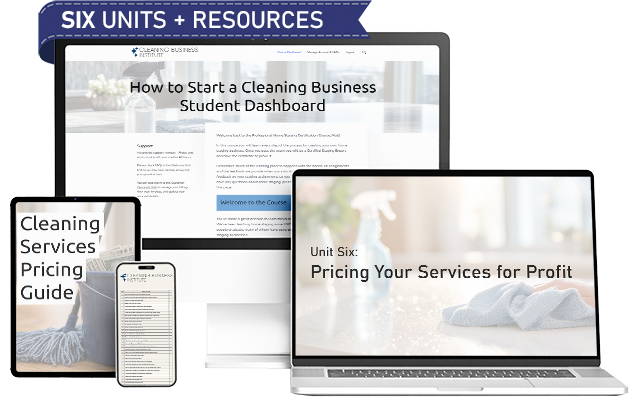
The course does not teach one state's rules, but it teaches how to find and apply them. Unit 1, Cleaning Business Foundations, covers the legal basics of structures, licenses and insurance. Unit 2, Setting Up Your Business, covers registering a name, permits, bookkeeping and the business bank account.
Unit 3, Pricing Your Services for Profit, is where a Florida owner learns to price residential and commercial work separately, with tax and taxed supplies built in. All three units are in the Fundamentals Course, which covers units 1 to 6.
Ready to get started?
Our step-by-step courses take you from where you are now to a credential you can show, with templates, an online exam, and a 30-day money-back guarantee.
See the courses