How to Start a House Cleaning Business in Seven Steps
To start a house cleaning business, decide which services and neighborhoods you will cover, register the business locally, buy liability insurance, and set prices from the time each home takes. Then write a checklist and a few simple policies, and find your first clients through people who already know you.
From there, the job is to turn those first clients into a regular weekly or fortnightly round. Startup costs are low, and most owners begin as the only cleaner.
The rest of this guide takes the steps in order. The part that decides whether a house cleaning business lasts is the last one, the recurring round. One-off jobs pay the bills for a month, but regular clients are what make the schedule, and the income, predictable.
The seven steps to a house cleaning business
House cleaning has one of the lowest barriers to entry of any small business. There is generally no state license specifically for cleaning, and the basic kit costs little. That openness is why a clear sequence helps, because it is easy to start cleaning before the business behind it exists.
Each step below hands something to the next, so the order is worth keeping.
- 1
Choose services and area
Decide on regular cleans, deep cleans or both, and draw a service area you can drive across quickly.
- 2
Register the business
Pick a name, check it is free, and complete your city or county registration.
- 3
Insure it
Buy general liability cover before the first job, and decide whether clients will expect a bond.
- 4
Set your prices
Time a few homes, cost your hours honestly and build a simple price list.
- 5
Write a checklist and policies
Agree what a clean includes, plus cancellation, payment and key rules.
- 6
Find the first clients
Start with friends, neighbors and local groups, then a free business listing.
- 7
Build the round
Convert one-off and trial cleans into fixed weekly or fortnightly slots.
The sections below expand the steps that new owners most often get wrong. For a printable version of the whole sequence, the cleaning business startup checklist breaks each one into tasks.
Choosing services and building a recurring round
Most house cleaning businesses sell two things. The first is the standard recurring clean, a maintenance visit that keeps a home at a set level. The second is the deep clean, a longer one-off visit that reaches baseboards, inside appliances and the places a regular clean skips.
The two work best together. A deep clean is the natural first visit for a new client, because it brings the home up to the standard your recurring clean will then hold. It also gives you a realistic measure of the time that home takes before you commit to a regular price.
Recurring work is where the business settles. O*NET's survey of maids and housekeeping cleaners finds most report a regular, set schedule.
Owners starting out show the same preference. Across the students we work with at the Cleaning Business Institute, close to nine in ten of those starting house cleaning businesses in the last two years plan their week around regular weekly or fortnightly clients rather than one-off jobs.
Specialty work can come later. Move-out cleans and short-term rental turnovers each have their own pricing and pressures, covered in our guides to a move-out cleaning business and an Airbnb cleaning business.
Pricing a house clean so it pays
House cleaning is usually sold at a flat price per visit, based on the size of the home, its condition and how often it is cleaned. Clients prefer it because they know what they will pay. The risk is that a flat price hides your real hourly rate, which is why it should be built from time, not guessed from a competitor's list.
Here is the working for one illustrative fortnightly clean. The assumptions are stated so you can replace them with your own.
Dividing $140 by three hours on site suggests $46.67 an hour. Taking out costs and counting the drive leaves $127 over 3.5 hours, or about $36 an hour, before tax.
That gap is normal, and knowing it is what lets you set a price on purpose. If $36 an hour is too low for your area, the fix is a higher price or a tighter service area, not faster cleaning. The cleaning price calculator gives a starting range by bedrooms, bathrooms, type of clean and frequency.
Our guide to cleaning business pricing compares flat, hourly, per-room and square-foot pricing, and when each one fits.
The checklist and policies that protect the price
A price only holds if both sides agree what it buys. That is the job of a written checklist, which lists the tasks in each room on a standard visit and the extras that cost more, such as inside the oven or the fridge. Our cleaning service checklist template is a starting point.
Alongside the checklist, a few short policies prevent most early disputes. Write them down and send them before the first visit.
- Cancellations. How much notice a client must give, and what a late cancellation costs.
- Payment. When payment is due, how it is taken, and what happens if it is late.
- Access. How keys and alarm codes are stored, and what happens if nobody is home.
- Safety. What you will not do, such as climbing ladders or moving heavy furniture.
New owners often skip this step because their first clients are friends. Those are exactly the clients with whom an unwritten rule is hardest to raise later.
Making a house cleaning business legal and insured
The legal setup for a small house cleaning business is modest, but it varies by city, county and state. Treat the list below as the usual shape and confirm the details with your own local government.
- Local registration. Most owners need a city or county business license or registration. The SBA's licenses and permits guide explains where to look.
- A business structure. Many start as sole proprietors and form an LLC later. Our post on registering a cleaning business walks through names and structures.
- A tax ID. An EIN is free from the IRS and required once you hire staff or form a partnership or corporation. The IRS EIN page explains who needs one.
- Sales tax, where it applies. Some states tax cleaning services, so check your state revenue department.
- Insurance. General liability cover protects you if you damage something in a client's home. Our guide to cleaning business insurance covers the options.
Bonding sits slightly apart from that list. It is not a legal requirement in most places, but some homeowners ask for it because you will hold their keys. A written policy for keys and alarm codes reassures them as much as the bond does.
Finding the first regular clients
With the business set up, the first clients nearly always come from people who already know you. A neighbor, a former colleague or a friend's parent is far more likely to let a new cleaner into their home than a stranger who found an ad. That trust is the asset to spend first.
The usual early sources, roughly in the order they pay off, are these.
- Friends, family and neighbors, asked directly and personally.
- Neighborhood groups online, where helpful answers come before any offer.
- A free Google Business Profile, with a review requested after every early clean.
- Real estate agents and property managers, who need move-out cleans regularly.
Each of those clients should leave with a fixed next date in the diary. A trial clean that ends with "let me know if you want me again" rarely turns into a regular slot. Our guide to getting clients for a cleaning business covers the first twenty in more detail.
How the course fits
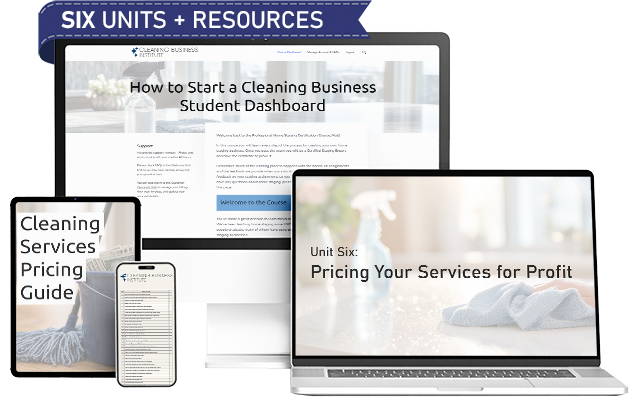
The Fundamentals Course is built for exactly this stage. Unit 1, Cleaning Business Foundations, covers choosing a niche and the legal basics. Unit 2, Setting Up Your Business, covers registration, bookkeeping and the cancellation and payment policies above.
Unit 3, Pricing Your Services for Profit, works through flat-rate, hourly and square-foot pricing with real cost math. Unit 4 covers cleaning standards room by room, Unit 5 covers keeping clients, and Unit 6, Getting Your First Clients, includes outreach scripts and introductory offers.
Ready to get started?
Our step-by-step courses take you from where you are now to a credential you can show, with templates, an online exam, and a 30-day money-back guarantee.
See the courses