Should I Start a Cleaning Business? An Honest Look
You should start a cleaning business if you can handle steady physical work, are comfortable asking strangers for business, and can live with uneven income for the first few months. It suits reliable, organized people who want control over their time and are happy to start small. It suits poorly anyone who needs a predictable paycheck right away or dislikes cleaning.
Those are the honest terms. Startup costs are low and no degree is required, which is why so many people consider it. The same low barrier means competition, and the work itself is harder on the body than it looks from outside. This guide sets out both sides so the decision rests on facts rather than hope.
The honest pros and cons
Every advantage of a cleaning business has a matching cost. The low barrier that lets anyone start is the same one that lets competitors start next door. The flexibility comes with the fact that nobody else will cover a missed clean.
Here they are side by side.
| What it gives you | What it asks back |
|---|---|
| Low startup cost | Low barriers mean plenty of competitors |
| No degree or special qualification | Clients judge you on trust and reviews instead |
| Control over your schedule | Clients still want daytime weekday slots |
| Paid per job, often quickly | Income is uneven until recurring clients build up |
| Easy to start part-time | Growth past your own hours means hiring |
If the left column appeals and the right column sounds manageable, that is a good sign. If the right column sounds like a dealbreaker, it probably is, and finding that out now costs far less than finding it out six months in.
Questions to ask yourself first
The decision mostly comes down to five questions. Answer them honestly, ideally out loud to someone who knows you well, since people tend to answer kindly in their own heads.
- Can my body take it? Cleaning means standing, bending, lifting and repeating the same motions for hours.
- Can I cover a few lean months? Savings or another income makes the slow start far less stressful.
- Do I have the hours? Even part-time, the business needs time for quotes, messages, travel and admin as well as cleaning.
- Will I ask for business? Clients come from asking neighbors, posting locally and following up, again and again.
- Can I handle complaints calmly? Some clients will be unhappy, sometimes unfairly, and the owner deals with every one.
The first question deserves the most weight, because it is the one people underestimate. O*NET's profile of maids and housekeeping cleaners reports that 84% of workers in the role stand continually or almost continually, and 70% bend or twist their body continually. You do not need to be an athlete, but the work is physical every day.
Who a cleaning business suits
The people who do well in this business tend to share a handful of traits more than any background. Experience in cleaning helps, but it can be learned in weeks. These traits are harder to learn.
- They show up when they said they would, every time.
- They notice the smudge on the light switch and the dust on top of the door frame.
- They work well alone, without anyone checking on them.
- They keep track of their own schedule, money and promises.
- They are patient enough to build slowly rather than expecting a full calendar in month one.
Reliability is the one that matters most to clients. A cleaner who arrives on time and does the same thorough job every visit keeps clients for years, and a cleaner who is brilliant but unpredictable does not. If a lack of experience is the main worry, the guide on starting a cleaning business with no experience covers how to close that gap.
Who it does not suit
The mirror image is just as useful. A cleaning business is usually the wrong choice for someone who dislikes cleaning their own home, who needs the same paycheck every two weeks to feel secure, or who struggles to be on time. It is also wrong for anyone hoping for quick money, since the early months are mostly about building a client base.
Recognizing a poor fit is not a failure. It is the cheapest lesson available.
What an ordinary week feels like
Beyond the traits, it helps to picture the week itself. A typical residential day is two or three homes, each taking two to four hours, with driving in between. Messages and quote requests arrive while your hands are in a sink, and most of them get answered at lunch or in the evening.
Evenings carry the admin. That means invoices, the bookkeeping, replying to new inquiries and planning tomorrow's route. Owners who protect one fixed admin slot a week find the rest of their evenings come back.
The scheduling freedom is real but narrower than people expect. Most residential clients want cleans on weekday mornings and early afternoons, while they are at work. That suits a parent working school hours very well. It suits someone hoping to work nights and weekends much less, unless they choose office cleaning, which runs after hours.
Finally, the mental load sits with the owner. When a client is unhappy, a car breaks down or a cleaner calls in sick, there is nobody else to hand it to. Some people find that freeing. Others find it wearing, and both reactions are worth knowing about before the first client signs.
What the money really looks like
The money side is where hopeful guesses do the most damage, so it is worth working through on your own numbers. Startup costs are modest for residential cleaning, mostly supplies, insurance, registration and some early marketing. The SBA's guide to calculating startup costs sets out how to list them, and the cleaning business startup cost calculator does the arithmetic for a cleaning business.
Income depends on price, hours and how many clients stay. Here is how that works on assumed figures. Five cleans a week at $137 brings in $685. Take off about $14 per clean for supplies and travel and the business keeps $615 before insurance, software and tax.
Tax is the part new owners forget. A self-employed owner pays self-employment tax on top of income tax, and the IRS sets that at 15.3% of net earnings on its self-employment tax page. Run your own figures through the cleaning business earnings calculator before deciding, and see how much a cleaning business makes for the fuller picture.
It also helps to know what most of these businesses look like. Across the cleaning companies we follow at the Cleaning Business Institute, about four in five are run by the owner alone, with no employees. That is a perfectly good business to own. It simply means the owner's own hours set the ceiling on income until they decide to hire.
A low-risk way to test it first
Nobody has to decide from an armchair. A month of real cleaning answers most of the questions above better than any amount of thinking, and it costs very little.
Here is a simple four-week trial.
- Weeks one and two. Clean two or three homes for friends or family, at a low price or free. Time every clean and notice how your body feels the next morning.
- Weeks three and four. Book two or three paid cleans from a local post or a referral. Go through the whole process, from quote to cleaning to collecting payment.
- The review. Ask yourself whether you enjoyed it, whether you were good at it, and whether the money felt worth the effort at that price.
Many people come out of the trial sure they want to go ahead, and they start with a few real clients already. Others decide it is not for them, which is just as valuable. Either way, the decision is now based on evidence.
How the course fits
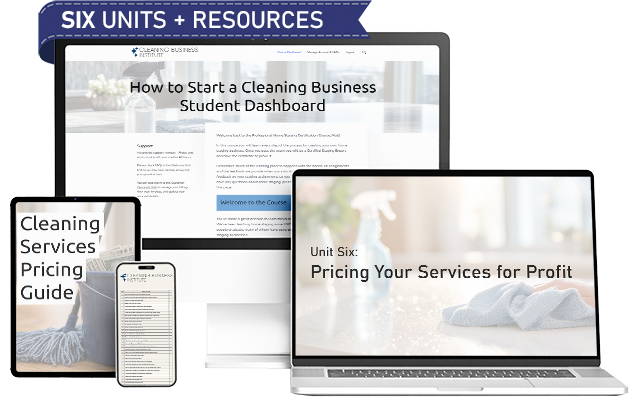
If the answer is yes, the next step is learning to do it well. The Fundamentals Course starts with Unit 1, Cleaning Business Foundations, which covers choosing a niche, a realistic launch budget and the legal basics. Unit 3 covers pricing for profit, and Unit 6, Getting Your First Clients, covers launching and booking those first paying homes.
The Fast Track Course adds four units for owners who already know they want to hire and grow. For the full launch route in the meantime, read the guide on how to start a cleaning business.
Ready to get started?
Our step-by-step courses take you from where you are now to a credential you can show, with templates, an online exam, and a 30-day money-back guarantee.
See the courses