Is a Cleaning Business Profitable, and What Makes It So
Yes, a cleaning business is usually profitable, because the main costs (labor, supplies and driving) are small next to what a well-priced clean earns. But profit is not automatic. It depends on the margin left on each job, and that margin is decided by price, labor time, drive time and how full the schedule is.
That last point matters more than most new owners expect. The Federal Reserve's Small Business Credit Survey found that only about 46% of employer firms, across all industries, were operating at a profit. Cleaning starts with an advantage, since it needs little equipment, but a business that hires people can still lose money one job at a time.
Gross margin and net margin, the two numbers that show profit
Profit in a cleaning business is easiest to see job by job, so it helps to name two measures. Revenue and owner pay are a separate question, which our guide to how much a cleaning business makes works through for a solo cleaner and a small team.
The two margin measures answer different questions:
- Gross margin is the price of a job minus the costs that job causes directly, such as the cleaners' wages, supplies and the drive there, shown as a share of the price.
- Net margin is what remains after the business's fixed overheads, such as insurance, software, phone and marketing, are spread across every job.
Gross margin tells an owner whether a job is priced properly. Net margin tells them whether the business as a whole is profitable. A business can have healthy gross margins and still show a thin net margin if the schedule has too many gaps to carry the overheads.
Why a solo cleaner's margin looks so high
When the owner does the cleaning, their own time is not a cost line, so almost every dollar looks like profit. That is real money, but it is pay for labor as much as profit from a business. The margin only shows its true shape once someone else is on the payroll doing the work.
Where the money goes on one team-cleaned job
So the clearest test of profitability is a job the owner does not clean. The worked example below is an illustration, not a market figure. It assumes a recurring house clean priced at $180, done by two employed cleaners paid $18 an hour, with payroll taxes and workers' compensation at 15% of wages.
Each cleaner spends two hours in the house and half an hour driving, so the job buys five paid hours. Driving is costed at the IRS standard mileage rate of 76 cents a mile, and overheads of $24,000 a year are spread across 1,000 team jobs.
About 20 cents of each dollar is left as profit, and the owner's own pay for running the business comes out of that.
The ledger shows where profit really lives. Labor takes well over half of the price, so anything that changes labor time changes profit far more than a cheaper supplier ever could. A dollar saved on product is a dollar. Half an hour saved on two cleaners is more than ten.
What drives profit in a cleaning business
Because labor dominates, the levers that move profit are mostly about time and price. The table below starts from the same $180 job and its $36.90 of net profit, then changes one thing at a time.
| The change | Working | Net profit |
|---|---|---|
| Price raised by $10 | All of it reaches profit | $46.90 |
| Drive cut to 15 minutes each | Half a paid hour saved, plus on-costs | $47.25 |
| Job runs 30 minutes over | One extra paid hour, plus on-costs | $16.20 |
| One cleaner sent back to redo a room | 1.5 paid hours plus 10 more miles | −$1.75 |
| Price up and drive cut together | Both gains on one job | $57.25 |
One return visit wipes out the profit on the job, which is why a written checklist and a final walk-through earn their keep. A modest price rise and a tighter route, on the other hand, together lift profit by more than half.
Those results point to the levers worth watching, roughly in order of effect:
- Price against the hours a job really takes. A price set from a guess rather than a timed clean is the most common source of thin margins. Our guide to how to charge for cleaning services shows how to build a price from cost.
- Drive time and route density. Clients grouped by area mean less paid time in a car. Route density means how close together a team's jobs sit on a given day.
- Schedule fill. Overheads are the same whether a team cleans four homes a day or two, so gaps in the diary push net margin down even when every job is priced well.
- Re-cleans and complaints. Each one is unpaid labor. Training and checklists cost less than callbacks.
- Staff turnover. A new cleaner is slower for weeks, and slower means more paid hours on the same price.
How margins differ for house, commercial and specialty work
The same levers apply across the trade, but they bite differently depending on the kind of work. Knowing which pressure a niche brings helps an owner decide where to look first when profit slips.
House cleaning carries the most driving, because each job is a separate trip. Its strength is recurring clients, who fill the schedule without fresh marketing each week. Margin depends heavily on route density and on keeping the time each home takes close to the time it was priced at.
Commercial cleaning usually earns less per hour than a house clean, but a building can mean several hours of work in one place with no drive between rooms. Contracts are often paid on 30-day terms, so cash arrives after the wages go out. O*NET's profile of janitors and cleaners puts their median wage at $17.71 an hour, a useful base for costing evening labor.
Specialty work, such as move-out, carpet or post-construction cleaning, earns a higher price per job. It also brings equipment that wears out and one-off clients who must be found again each time. The equipment cost belongs in the price, not in the owner's head.
How to check whether your own cleaning business is profitable
Knowing the levers is only useful once an owner can see their own numbers. The checks below take an afternoon with a year of invoices and bank statements, and they answer the question better than any average.
- Time five typical jobs from arrival to departure, add the drive, and compare the paid hours with what each job was priced at.
- Work out the gross profit on those five jobs, using the ledger above as a pattern.
- Add up a year of fixed overheads and divide by the number of jobs, to find what each job must carry.
- Count re-cleans, refunds and unpaid invoices over the last quarter, since each one comes straight off profit.
- Find the break-even point, the number of jobs a month that covers all costs. The SBA's guide to calculating startup costs includes a break-even analysis.
Owners who run these checks are often surprised by what they find. Across the students we work with at the Cleaning Business Institute, a little under half of those who already employed cleaners when they enrolled over the past two years were running at a profit at the time. In most of those cases the trade was fine and the prices were out of date.
For a broader view of earnings by business size, see how much a cleaning business can make. The cleaning business earnings calculator lets you test a different price, schedule or team size against your own costs in a few minutes.
Where the course covers margins and pricing
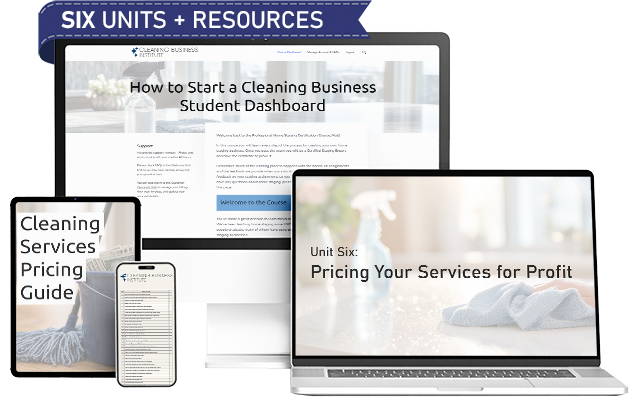
The Fundamentals Course covers the profit side a solo owner controls. Unit 3, Pricing Your Services for Profit, teaches the true cost of running a cleaning business and how to set prices that hold a margin from the first job. Unit 4, Cleaning Techniques and Standards, covers working efficiently so jobs finish in the time they were priced at.
The team side of the ledger belongs to the Fast Track Course. Unit 8, Systems for Efficiency, covers scheduling, checklists and routes. Unit 9, Hiring and Growing Your Team, covers training cleaners to a standard, which is what keeps re-cleans and overruns from eating the margin.
Ready to get started?
Our step-by-step courses take you from where you are now to a credential you can show, with templates, an online exam, and a 30-day money-back guarantee.
See the courses